Natal Chart Transits — Your Current Transits, Live
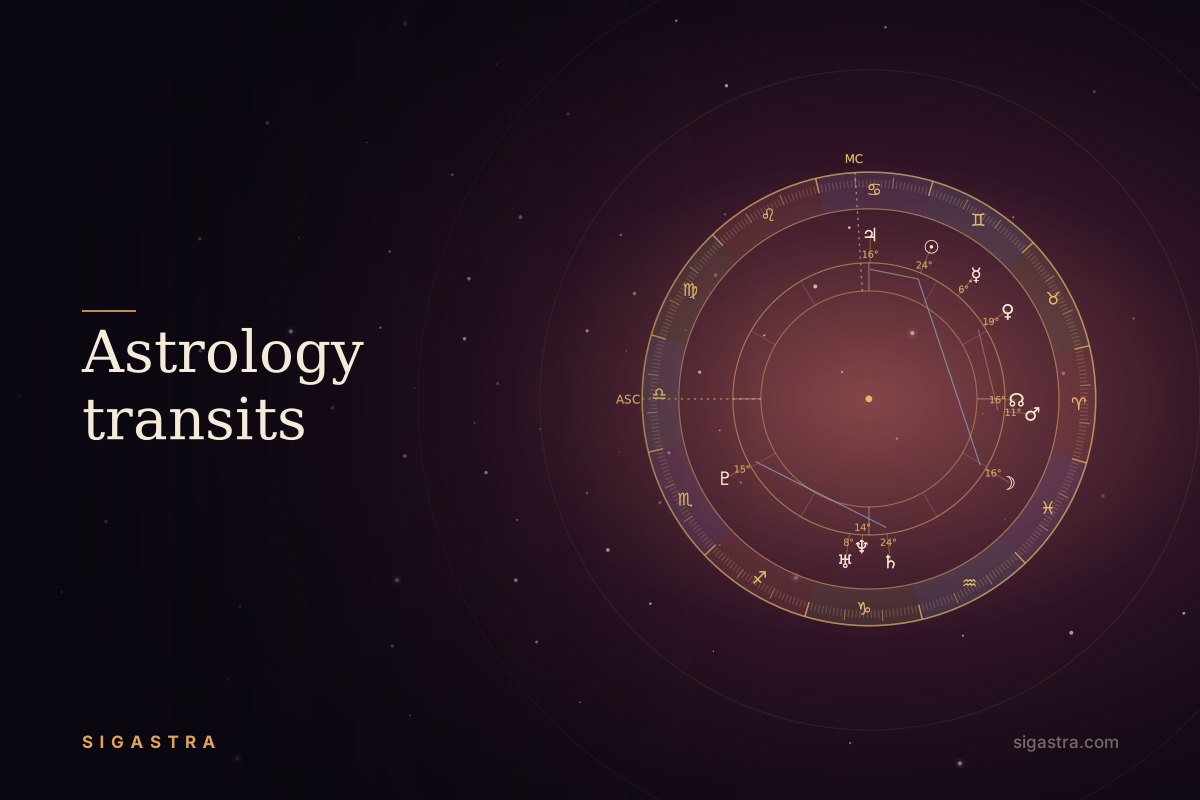
Your current transits, computed live against your birth chart — which planets are activating your natal placements right now, with exact dates and today’s transit wheel. Free to compute; Pro adds the animated timeline and an AI reading.
Transits are measured against your natal placements. Calculate your full birth chart free.
What is a transit chart?
A transit chart shows where the planets are in the sky right now, laid over your birth chart, so you can see exactly which transiting planets are contacting your natal placements. Transits are how astrology describes timing — the moving sky triggering the fixed picture you were born with.
Sigastra computes both charts from the real ephemeris (observatory-grade ephemerides): your natal positions from your birth moment, and the live transiting positions for today. The wheel above shows your natal planets on the inner ring and the current transits on the outer ring, with the aspect lines between them.
Reading your current transits
The table lists every transit currently within orb of a natal point, tightest first, with its exact-hit date and whether it is applying (building) or separating (fading). Applying aspects are the ones gathering force; separating ones are on their way out.
Fast movers — the Moon, Sun, Mercury, Venus — colour the day and the week. The slow outer planets — Jupiter, Saturn, Uranus, Neptune, Pluto — mark the bigger chapters, sometimes holding an aspect for months and returning two or three times when they station retrograde.
The transit timeline (Pro)
Free shows today. Pro unlocks the animated timeline: scrub forward and back across the coming months and watch the transiting planets move around your wheel, with every exact aspect marked on the track so you can see what is coming and when it peaks.
Pro also adds an AI transit reading that interprets your current transits in plain language — the overall climate, the standout contacts, and the timing of what is building versus fading.
Why birth time matters for transits
Transits to your Ascendant, Midheaven and Moon depend on an accurate birth time — the angles move about a degree every few minutes, and the Moon changes sign every ~2.5 days. With a precise time, transits to your angles and houses become meaningful; without it you can still read transits to the planets.
For your exact natal placements, calculate your full birth chart first — everything on this page is measured against it.
How long a transit lasts, planet by planet
A transit chart is also searched for as a horoscope transit chart, and both names mean the same wheel: your natal chart with the current sky drawn around it. The single most useful number in reading one is the speed of the planet doing the transiting, because that is what sets the duration. The Moon crosses a degree in about two hours, so a lunar transit is an afternoon. Mercury and Venus take a day or two per degree at normal speed. Mars takes several days, and a Mars transit is usually read across a week or two.
The slow planets are a different scale entirely. Jupiter takes about two weeks to cover the three degrees on either side of an exact contact, so a Jupiter transit is a month or so. Saturn takes around three months of forward motion, then usually goes retrograde back over the same point and comes forward a third time — roughly a year with three exact dates. Uranus, Neptune and Pluto stretch that further still, and a Pluto transit to a natal point can run for two or three years.
This is why the same aspect means completely different things depending on who is making it. The Moon square your Sun is a mood; Saturn square your Sun is a chapter. When two sources appear to disagree about what a square means, they are very often reading different planets at different speeds and are both right.
Orbs — why a transit starts before the exact date
A transit does not switch on at the moment of exactness. Astrology works with an orb, a tolerance in degrees around the exact angle, and the transit is considered active across that whole range. Sigastra uses a tight orb for transits so the timeline stays useful, but even a tight orb means the effect builds before the date and fades after it.
The practical shape is a curve rather than a switch. The transit becomes noticeable as the planet enters orb, peaks at exactness, and eases off as it separates. Anyone waiting for something to happen on the exact date and concluding astrology failed when nothing did has misread what the date is: it is the top of the curve, not an appointment.
Retrograde motion complicates it in a useful way. When a slow planet stations retrograde inside the orb, it crosses the same point three times — forward, back, forward again — and the tradition reads those three passes as a sequence: something arrives, gets reconsidered, then settles. The three dates are computable years ahead; what fills them is not.
Which transits need an exact birth time, and which do not
Transits to your Sun, Mercury, Venus, Mars and the slow planets work from a birth date alone, to about a degree. Those placements move slowly enough that a few hours of uncertainty does not move them meaningfully, so a chart without a time still produces a usable transit list for most of the planets.
Transits to the Moon, the Ascendant and the Midheaven are a different matter. The Moon covers about thirteen degrees a day and the Ascendant a whole sign every two hours, so an hour of error can put both in the wrong place entirely. Without a reliable time, those transits cannot be dated honestly and are better left out than guessed.
The same limit applies to house-based transit readings. Saying that a transit falls in your seventh house is a statement about the houses, and the houses rotate with the Ascendant. If your birth time is uncertain, the sign-based half of a transit reading still holds and the house-based half is the part to treat carefully — which is more useful than presenting both as equally solid.
One more thing the timeline cannot show you: transits do not arrive one at a time. On any given month several are in orb at once, and the way they combine matters more than any of them alone. A Jupiter transit inside a Saturn transit reads as growth that has to be earned; the same Jupiter transit on its own reads as an opening. Reading the strongest transit in isolation is the most common way a technically correct list produces a misleading conclusion.
Transit chart FAQ
What are my current transits?+
Your current transits are the aspects the planets in the sky right now are making to your birth chart. Enter your birth details above and Sigastra computes them live, tightest first, each with its exact date.
Is the transit chart calculator free?+
Yes. Your chart, the current transits with exact dates, and today’s transit wheel are free. Pro unlocks the animated ±months timeline scrubber and an AI interpretation of your transits.
What does applying vs separating mean?+
An applying transit is still tightening toward exact — its influence is building. A separating transit has already passed exact and is fading. The table marks each one and gives the exact date.
How long does a transit last?+
It depends on the planet. The Moon’s transits last hours; the Sun and inner planets a few days; the outer planets (Jupiter through Pluto) can hold an aspect for weeks or months, often returning two or three times across a retrograde.