Lunar Return Chart — Your Month Ahead
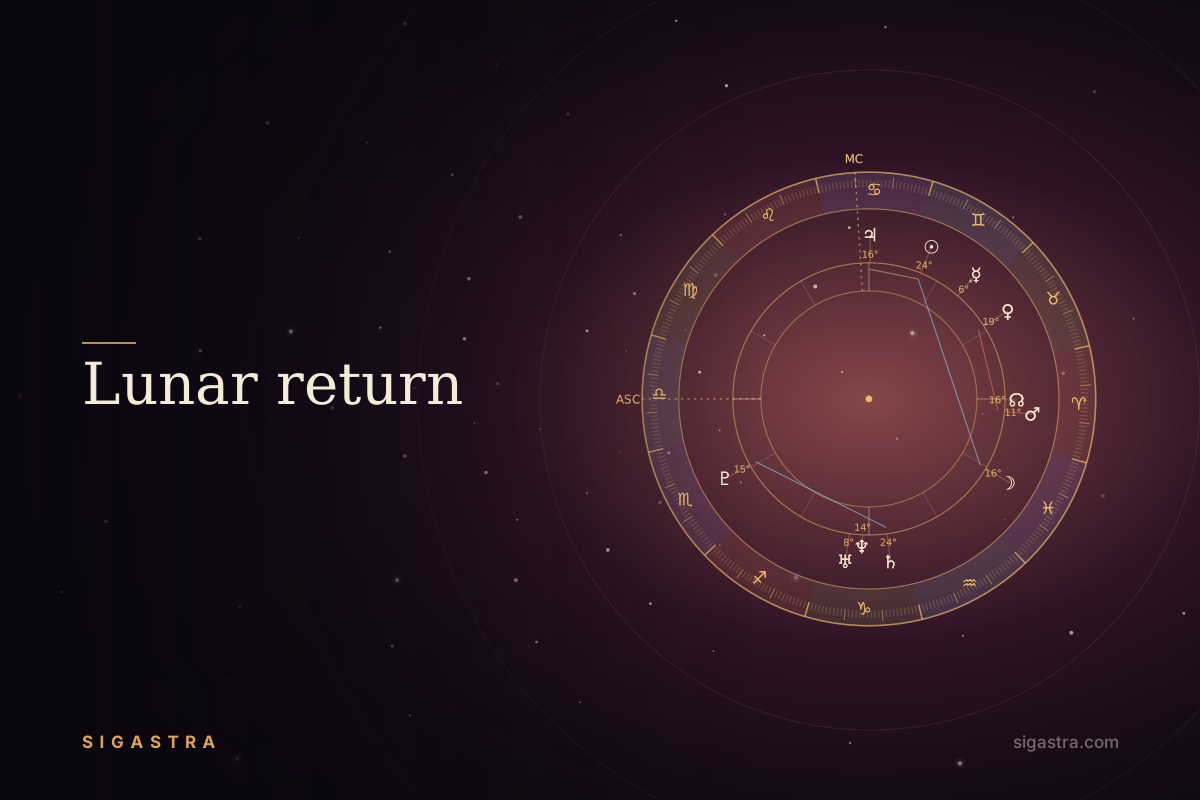
Cast for the exact moment the Moon returns to its natal position each month, your lunar return chart is a forecast of the weeks ahead — the rising sign of the return, the house holding the Moon and the placements that set the month’s emotional tone. Free to compute; Pro adds the full month-ahead reading.
A lunar return is read against your natal chart. Calculate your full birth chart free.
What is a lunar return?
A lunar return is a fresh chart cast for the exact moment the Moon comes back to the precise degree it occupied when you were born. Because the Moon is the fastest-moving body in astrology, it completes that circuit in about 27.3 days — so a new lunar return arrives roughly once a month, marking the start of your personal emotional cycle.
Sigastra computes the return from the real ephemeris (observatory-grade ephemerides), finding the Moon’s exact natal longitude and the next moment it is matched again. The wheel above is that return chart: the same planets you know from your natal chart, re-arranged into the signs, houses and angles that set the mood of the month ahead.
Reading your lunar return
Start with the return Ascendant — the rising sign of the lunar return frames how you meet the month and the tone of the weeks it covers. Then find the house holding the return Moon: that house shows where your emotional attention is drawn, the part of life that feels most alive and most sensitive until the next return.
Read the Moon’s house and sign alongside the return Sun, Venus and Mars to fill out the picture — where your energy goes, what you are drawn to, and where the friction sits. The lunar return is a monthly weather report layered over the fixed landscape of your birth chart.
How often it happens
The Moon returns to its natal position about every 27.3 days, so you receive roughly thirteen lunar returns across a year — a little more than one a month. Each one opens a fresh emotional cycle, which is why the lunar return is read as a short-term forecast rather than the year-long portrait of a solar return.
Because the return moment shifts a few days earlier each month, the calculator computes it to the minute from the current date, giving you the exact instant the Moon comes home and the chart drawn for it.
Lunar return vs solar return
A solar return is cast once a year, on or near your birthday, when the Sun comes back to its natal degree — it describes the overarching theme of the twelve months ahead. A lunar return is its monthly counterpart: the Moon returns roughly every four weeks, colouring the emotional tone of a single cycle.
The two work best together. Read the solar return for the story of your year, then use each lunar return to see the mood of the month within it — the shorter rhythm nested inside the longer one.
How to use a lunar return across an actual month
The lunar return rewards being read twice, and it rewards written observations more than memory does. At the start of the month, note two things: which house the Moon falls in and what the Ascendant of the return chart is. Then look again four weeks later and see what the month actually turned out to be about. After three or four cycles you will know whether this tool describes anything for you, which is a more honest standard than any interpretation offered in advance.
The chart is cast for the moment the Moon returns to the exact degree it held at your birth, which happens about every twenty-seven days and a third — not once a calendar month. That drift is why lunar return dates walk backwards through the calendar and why some calendar months contain two returns and others contain one.
Read alongside the solar return, it fills in a gap. The solar return describes the year; the lunar return describes how each month within that year is coloured. When the two point at the same house, that month is usually where the year's theme actually becomes visible.
Which location to use, and why it changes the chart
A lunar return is cast for a place as well as a moment, and the choice of place changes the houses and the Ascendant while leaving every planetary position identical. That makes it the one decision that materially changes the reading, and there is no universal agreement about it.
The two common conventions are the birthplace and the place you are actually living when the return occurs. The argument for the birthplace is consistency: the chart stays comparable year to year. The argument for the current location is that the houses describe your circumstances, and your circumstances are where you are. Sigastra computes from the details you enter, so you can cast it both ways and compare.
One caution worth stating plainly: relocating a return chart to a place you merely intend to travel to, in order to obtain a more appealing Ascendant, is a practice with no support in the tradition and no mechanism behind it. Casting the chart for where you actually are keeps it describing something.
There is one more limit worth being explicit about, because it decides whether this tool is worth your time at all. A lunar return chart is cast to the exact minute the Moon reaches its natal degree, and that moment depends on the natal degree being right — which depends on your birth time. The Moon covers about thirteen degrees a day, so an hour of uncertainty moves your natal Moon by roughly half a degree and moves the return moment by about an hour. For the sign and house of the return Moon that is usually survivable; for the return Ascendant, which shifts a full degree every four minutes, it is not.
Lunar return FAQ
What is a lunar return?+
A lunar return is a chart cast for the exact moment the Moon returns to the position it held at your birth. It happens about once a month and is read as the emotional theme of the weeks ahead — a short-term forecast layered over your birth chart.
How often is a lunar return?+
Roughly monthly. The Moon returns to its natal degree about every 27.3 days, so you get around thirteen lunar returns a year — a little more than one each calendar month.
Is the lunar return calculator free?+
Yes. Casting your lunar return chart, seeing the exact return moment, the return wheel and your key placements is free. Pro adds a full AI reading that interprets the chart as the emotional themes of your month ahead.
Should I use my birthplace or current location?+
The planets are the same either way. Cast for your birthplace for the classic reading, or tick the current-location option to recast the same return moment for where you live now — the planets stay put while the houses and angles shift to your present horizon.