Composite Chart — Your Relationship as One Chart
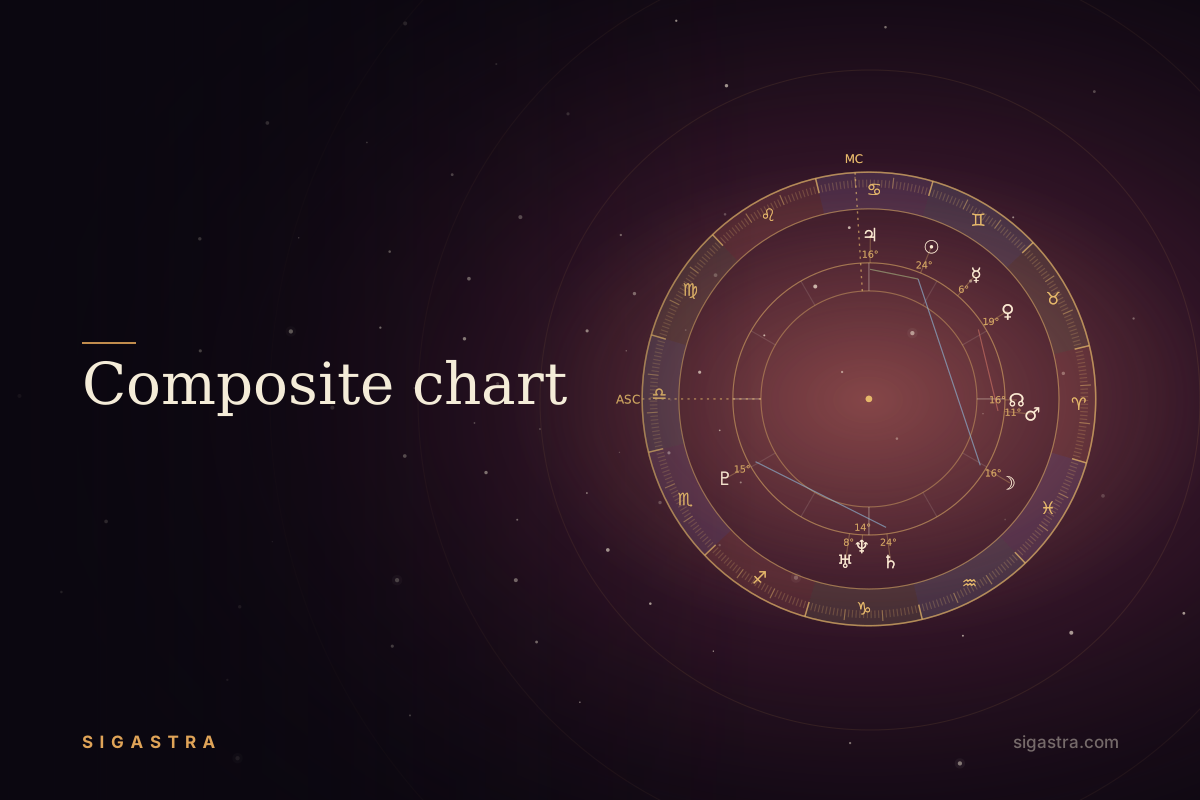
The composite chart takes the midpoint between two people’s placements and draws them as one wheel — a chart of the relationship itself. Enter both birth details to compute it free; Pro adds the full interpretation and the Davison chart.
The composite is built from two natal charts. Calculate your own full birth chart free.
What is a composite chart?
A composite chart is a single chart built from two people. Instead of comparing your chart against your partner’s, it takes the midpoint between each pair of placements — the point halfway between your Sun and theirs, your Moon and theirs, and so on — and draws one new wheel from those midpoints. The result is a chart of the relationship itself, not of either person.
Sigastra computes both natal charts from the real ephemeris, then derives the composite by the midpoint method. The wheel above is that combined chart: read it as an entity in its own right — the “third thing” the two of you create together.
Reading your composite
Start with the same three points you would read in any chart. The composite Sun is the relationship’s core identity — its reason for being and where it shines. The composite Moon is its emotional nature — what the bond needs to feel safe and nourished. The composite Ascendant is the face the relationship shows the world and how it first comes across.
From there the composite planets and aspects describe how the relationship communicates, what draws it together, and where it meets friction. Because it is one chart, every aspect is a statement about the partnership as a whole rather than about one partner reacting to the other.
Composite vs Davison
These are two different “relationship charts” and it is worth knowing which is which. The composite chart is a mathematical midpoint chart — it averages the positions of the two people, so it has no single date or place of its own. The Davison chart, by contrast, is a real chart cast for the midpoint in time and the midpoint in space between the two births.
Because the Davison is an actual moment on the calendar, it has a genuine Ascendant, houses and lunar phase, which many astrologers find grounds the reading. Sigastra Pro casts the Davison alongside the composite so you can compare the two.
Composite vs synastry
Synastry and the composite answer different questions. Synastry lays your two charts side by side and reads the aspects between them — your Venus to their Mars, your Moon to their Saturn — describing how you affect each other. It keeps both people visible as separate individuals.
The composite collapses the two into one chart and reads the relationship as a single being with its own purpose, needs and challenges. Most astrologers use both: synastry for the chemistry between you, the composite for the character of the thing you have built.
How to read a composite without asking it the wrong question
The most common misreading is holding the composite against your own chart and asking who dominates whom. That cannot be read from it: in the midpoint method the origin of every position disappears, by construction. A composite Venus in Scorpio says this connection seeks closeness intensely and exclusively — it does not say which of you brings that.
If who-brings-what is the question, the tool is synastry, which keeps the two charts separate and reads the contacts between them. The composite answers a different question: what the two of you produce together, independent of who contributed which part. Both are legitimate, and using one to answer the other's question is where composite readings usually go wrong.
The other thing worth checking early is the composite Ascendant, which needs both birth times. Without them the midpoint wheel still computes from the planets, but the houses — the part that says which area of life the relationship concentrates in — are not reliable, and are better left unread than read hopefully.
When a composite chart is not the right tool
A composite describes a relationship as a single entity, which means it needs there to be one. For a connection that is new, undefined, or one-sided, the composite tends to describe something more coherent than what actually exists, and reading it can produce a confidence the situation does not support.
It is also not a compatibility score. Nothing in a composite says whether a relationship will last, and a chart with hard aspects is not a warning any more than a chart with easy ones is a promise. What the aspects describe is the shape of the work — where the friction sits and what it is about — which is more useful than a verdict and less satisfying.
Composites of more than two people are technically computable and are usually a bad idea. The midpoint method assumes two positions to average; extending it to a family or a team produces a chart that is mathematically valid and interpretively empty. Where a group genuinely needs a chart, astrologers normally use the founding moment of the group instead.
One practical note on how to compare composites, since people usually build more than one. A composite is only meaningful against itself over time, not against someone else's composite: there is no scale on which one relationship chart is better than another, and the aspect counts do not rank. What can be compared usefully is the same composite read at different stages — what the transits are doing to it now versus a year ago — because that keeps the chart fixed and lets the sky supply the difference. Comparing two couples' composites tends to produce a verdict, and a verdict is the one thing this chart is least equipped to give.
Composite chart FAQ
What is a composite chart?+
A composite chart is one chart made from two people by taking the midpoint of each pair of placements — halfway between your Sun and theirs, your Moon and theirs, and so on. It describes the relationship itself as a single entity rather than either partner individually.
What’s the difference between composite and synastry?+
Synastry compares your two separate charts and reads the aspects between them, keeping both people distinct. The composite merges the two into one chart and reads the relationship as a single being. They answer different questions, and most astrologers use both.
What is a Davison chart?+
The Davison chart is a real chart cast for the midpoint in time and place between two births — an actual moment on the calendar, so it has a genuine Ascendant, houses and moon phase. Unlike the composite (a mathematical midpoint), it is a chart you could have cast for a real event. Sigastra Pro adds it alongside the composite.
Is the composite calculator free?+
Yes. The composite wheel and its key placements — composite Sun, Moon and Ascendant — are free. Pro adds the full written interpretation of the composite chart and the Davison chart.