Saturn Return — When Is Yours & What It Means
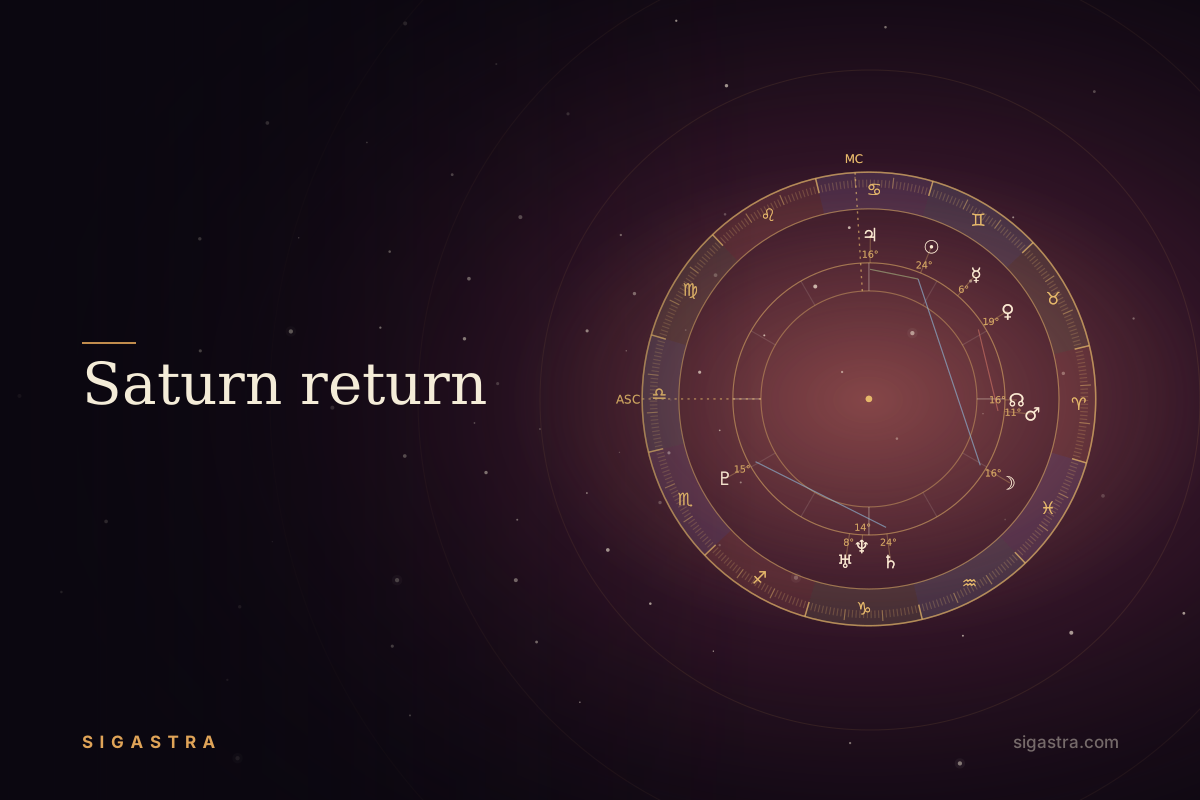
Saturn returns to its birth position about every 29.5 years, marking the great maturity thresholds of a life. Enter your birth details to find your 1st, 2nd and 3rd Saturn return dates, the sign, and what each passage asks of you.
Your Saturn return is measured against your natal Saturn. Calculate your full birth chart free to see its sign and house.
What is a Saturn return?
A Saturn return is the moment the planet Saturn comes back to the exact place in the zodiac it occupied when you were born. Saturn takes about 29.5 years to complete one orbit of the Sun, so it returns to its natal degree roughly every three decades — a slow, structural rhythm that marks the major maturity thresholds of a life.
Astrologically, Saturn is the planet of time, structure, responsibility and consequence. When it returns to its birth position it presses on whatever you have built so far: careers, commitments, identities and foundations are tested for how solid they really are. What is genuine tends to consolidate; what was borrowed, avoided or hollow tends to fall away. It is less a punishment than a reckoning — the universe asking whether the life you are living is actually yours.
When is your Saturn return?
Because Saturn’s orbit is close to 29.5 years, most people meet their first Saturn return around ages 29–30, the second around 58–59, and the third — if they reach it — around age 87. The calculator above roots out the exact dates from your birth chart rather than assuming the average, so your numbers may sit a little either side of those figures depending on where Saturn was when you were born.
Each return is a window rather than a single day. Saturn moves slowly and goes retrograde for months every year, so as it approaches its natal degree it often makes three exact passes — forward, back, then forward again — spread across roughly one to two years. The dates the tool gives you are the exact-contact peaks of that longer passage.
What it means
The flavour of your Saturn return is coloured by the sign and house Saturn occupies in your birth chart. The sign describes the style of the lesson — Saturn in a fire sign works through courage and initiative, in an earth sign through material security and craft, in an air sign through ideas and relationships, in a water sign through emotional foundations and belonging. The house shows the arena of life where the pressure and the rebuilding are concentrated.
Whatever the placement, the themes rhyme: structure, responsibility, endings and foundations. The first return is about building the scaffolding of an adult life; the second about reviewing and pruning it; the third about distilling meaning from the whole. In every case Saturn rewards commitment and honest effort, and it removes what cannot bear weight.
How to work with it
The worst way to spend a Saturn return is to brace against it. Saturn does not respond to wishful thinking; it responds to work, patience and honesty. Use the window to build something real — finish the training, sign the commitment, take on the responsibility you have been circling. Effort made now tends to set for decades.
It is equally a time to release what is hollow: the job that never fit, the relationship running on habit, the identity you outgrew. Let those endings happen rather than clinging. Look to your natal Saturn’s sign and house for where to focus, calculate your full birth chart for the detail, and check your current transits to see exactly when the pressure peaks.
Three passes, not one date
A Saturn return is almost never a single moment. Saturn typically stations retrograde while it is inside orb of your natal position, which means it crosses the same degree three times — direct, retrograde, then direct again — across roughly a year to eighteen months. The three exact dates are computable decades in advance, and the tradition reads them as a sequence rather than as three copies of one event.
The usual shape described is arrival, reconsideration and settlement. Something becomes unavoidable at the first pass, gets reopened or reversed at the second, and reaches a form you can live with at the third. Not every return follows that neatly, and some occur with no retrograde at all — a single pass — which tends to be experienced as more abrupt and less drawn out.
Knowing there are three passes changes how the period is read while it is happening. People who expect one date frequently conclude at the second pass that everything has come undone, when the pattern the tradition describes has that step built into it.
The second and third returns, and what changes
The first Saturn return, around twenty-nine, is the one that gets written about, and it lands where most people are being asked to commit to a direction. The second, around fifty-eight to fifty-nine, is described very differently: less about choosing a life and more about auditing the one that was chosen, often around work, health and what will actually be carried forward.
A third return, near eighty-seven, reaches a minority of people and has a much thinner literature behind it for the obvious reason. What is written about it tends to concern legacy and letting go of obligation rather than taking any on.
The half-returns are worth knowing about too. Saturn opposes its natal position around fourteen to fifteen and again around forty-four, and the squares fall roughly at twenty-two and thirty-seven. Those four points divide the twenty-nine-and-a-half-year cycle into quarters, and taken together they describe a rhythm rather than four isolated crises — which is a fairer reading than treating each as a separate verdict.
One clarification about the age, since it is quoted loosely almost everywhere. The Saturn return does not happen at thirty; it happens when Saturn reaches the degree it occupied at your birth, which falls somewhere between twenty-eight and a half and thirty depending on where Saturn was moving in its cycle when you were born. People born with Saturn retrograde or near a station can find their return arriving noticeably earlier or later than a friend born the same year. Computing your own dates takes a moment and is more use than any age given as a round number.
Saturn return FAQ
When is my Saturn return?+
Your first Saturn return lands around ages 29–30, the second around 58–59, and the third around 87. Enter your birth details above and Sigastra computes the exact dates from your chart rather than the average.
How long does a Saturn return last?+
Roughly one to two years. Because Saturn stations retrograde each year, it usually makes up to three exact passes over its natal position as it approaches, so the return is a longer chapter with a few peak dates rather than a single moment.
What does the Saturn return mean?+
It marks a maturity threshold — a reckoning about structure, responsibility, endings and foundations. Saturn tests what you have built: what is solid consolidates, and what is hollow tends to fall away. The sign and house of your natal Saturn shape the exact themes.
Is the Saturn return calculator free?+
Yes. Entering your birth details and getting your 1st, 2nd and 3rd Saturn return dates, the sign and the meaning of each is completely free.