Your birth chart (natal chart), precisely calculated
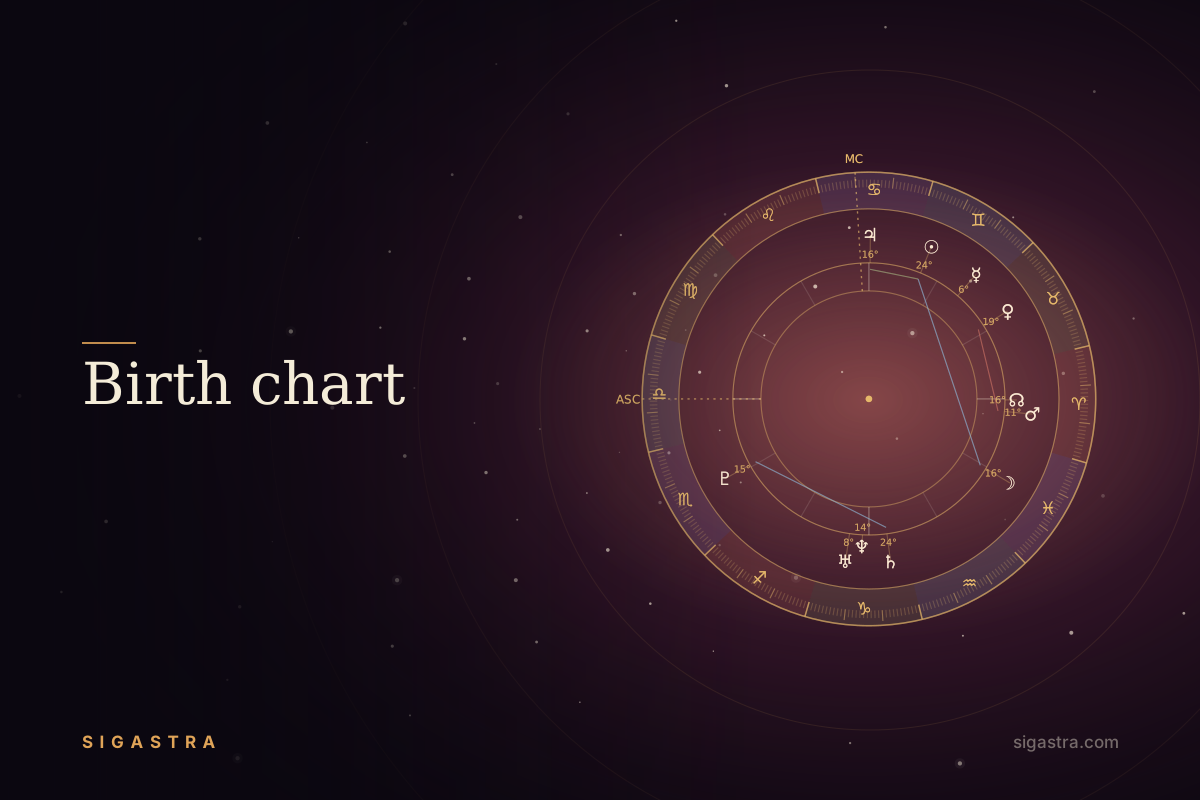
Sigastra computes your real natal chart from observatory-grade ephemerides and the historically-correct timezone for your birthplace — not a guess from a chatbot. Enter your birth details to see your chart.
A birth chart (natal chart) is a snapshot of the sky at the exact moment and place you were born — the positions of the Sun, Moon and planets across the twelve houses. It is the foundation every serious astrologer starts from.
The birth time matters more than people think: it sets your Rising sign and the house cusps, which can shift the whole interpretation. Even a few minutes changes the Ascendant. That is why we ask for the exact time and use the real historical timezone — including old daylight-saving rules — for your city.
Sigastra calculates everything deterministically from astronomy, then explains it in plain, human language — in your own tongue. Your chart, and your daily reading, are grounded in the real sky, never invented.
What a birth chart actually is
A birth chart — also called a natal chart or horoscope — is a map of the sky as it looked from your exact birthplace at the exact minute you were born. Astrology treats that single frozen moment as a kind of cosmic fingerprint: the Sun sat in one zodiac sign, the Moon in another, and each planet occupied its own degree of the 360-degree circle. A birth chart calculator turns your birth date, time and place into that map so you can read every position at a glance.
The wheel you see is divided two ways at once. The twelve zodiac signs form the outer band and describe the "how" — the tone and style of each planet. The twelve houses form the inner slices and describe the "where" — the area of life each planet colours, from identity and money to relationships and career. Where a planet lands in both systems, and how it connects to the others, is what makes your chart yours and no one else's.
None of this is invented. The positions come from real astronomy — the same ephemeris data used by observatories and navigation software. A good natal chart calculator does the mathematics precisely, then astrology supplies the meaning laid over the top.
Why your exact birth time matters
Most free horoscopes only need your birth date, because the Sun moves slowly and stays in one sign for about a month. But the two most personal points in your chart — your Rising sign (Ascendant) and your house cusps — depend on your birth time, and they move fast. The Ascendant shifts through the entire zodiac every twenty-four hours, roughly one degree every four minutes.
That speed is why a precise time changes everything. Two people born in the same city on the same day, a couple of hours apart, can share a Sun sign yet have completely different Rising signs, different houses for every planet, and a noticeably different reading. If you know your birth time to the minute, enter it — the chart it produces is far richer. If you do not, you still get an accurate reading of every planet by sign; only the time-sensitive layers (Rising and houses) are left out until you find it.
The planets in your chart, explained
Each body in your chart governs a different department of life. Together they read like a cast of characters — no single one is "you," but the whole ensemble is.
- Sun — your core
- The identity you are growing into: what you are here to express, where you shine, what gives you a sense of purpose.
- Moon — your inner world
- Emotions, instincts and what makes you feel safe. The private self behind the public one, and how you nurture and are nurtured.
- Rising (Ascendant) — your first impression
- The mask and doorway of the chart: how you meet the world and how the world first reads you, set entirely by your birth time.
- Mercury — mind and voice
- How you think, learn, speak and process information. Always close to the Sun, it colours your everyday communication.
- Venus — love and value
- What you find beautiful, how you show affection, what you want in relationships and what you are drawn to spend on.
- Mars — drive and desire
- Your engine: how you assert yourself, chase what you want, handle anger and take action under pressure.
- Jupiter — growth and luck
- Where life feels generous and expansive, where you find meaning, optimism and room to grow.
- Saturn — structure and discipline
- Where you meet limits, responsibility and hard-earned mastery. The teacher of the chart; slow, but it builds what lasts.
- Uranus, Neptune, Pluto — the outer planets
- Slow-moving generational forces: sudden change and freedom (Uranus), dreams and dissolution (Neptune), depth and transformation (Pluto). They matter most by house and aspect.
The twelve houses
If the planets are the actors and the signs are their costumes, the houses are the stage — the twelve life areas the drama plays out in. Their exact boundaries are set by your birth time and place, which is the other reason an accurate time is worth chasing.
- 1st — Self
- Identity, appearance, the way you begin things.
- 2nd — Resources
- Money, possessions, self-worth and values.
- 3rd — Communication
- Thinking, siblings, short trips, everyday learning.
- 4th — Home
- Family, roots, private life and your sense of belonging.
- 5th — Creativity
- Romance, play, self-expression and children.
- 6th — Work & health
- Daily routines, service, habits and wellbeing.
- 7th — Partnership
- Committed relationships, marriage and close one-to-one bonds.
- 8th — Depth
- Intimacy, shared resources, transformation and the taboo.
- 9th — Horizons
- Travel, philosophy, higher learning and belief.
- 10th — Career
- Vocation, reputation, ambition and public role.
- 11th — Community
- Friends, networks, hopes and long-term goals.
- 12th — The unseen
- The subconscious, solitude, endings and what is hidden.
Aspects: how the planets talk to each other
Planets do not act in isolation. The angles they make to one another across the wheel — the aspects — describe the conversations between different parts of you. A conjunction fuses two energies; a trine lets them flow together easily; a square creates friction that pushes you to grow; an opposition asks you to balance two pulls.
Aspects are what turn a chart from a list of positions into a portrait. They explain why your confident Sun might be quietly undercut by a cautious Saturn, or why your affectionate Venus feels effortless because a supportive Jupiter is cheering it on. Reading the aspects is where astrology stops being a horoscope for a twelfth of the world and starts describing the specific tensions and gifts that are yours.
How Sigastra calculates your chart
Behind the wheel, Sigastra runs on observatory-grade ephemerides — the same high-precision astronomical engine trusted by professional astrology software worldwide. Planetary positions are computed to the arc-second, not guessed and never invented by a language model. When you see a placement here, it is the real sky.
The harder problem is time itself, and it is where most free calculators quietly fail. To place your Ascendant and houses correctly we have to know the exact offset from universal time at your birthplace on your birth date — and time zones have changed constantly through history. Countries shifted zones, adopted and dropped daylight saving, and moved borders. Sigastra uses a full historical timezone database, so a birth in 1987 is calculated with 1987's rules, not today's. That accuracy on the time axis is the difference between a chart that is merely pretty and one you can actually trust.
Once the astronomy is fixed, the interpretation is written in plain, human language — in your own tongue. The numbers are exact; the words are there to make them mean something.
Birth chart vs. sun sign
When a magazine asks "what's your sign?", it means your Sun sign — where the Sun sat in the month you were born. It is real, but it is one twelfth of the story, shared by roughly six hundred million people. That is why generic sun-sign horoscopes so often feel vague: they have to speak to everyone born in a whole month at once.
Your full birth chart is the opposite. It layers your Moon, Rising and every planet across your personal houses, then reads the aspects between them. The result is specific to your birth moment and effectively unique. Calculating your chart here is the first step from "I'm a Leo" to actually understanding how the whole sky was arranged for you.
How to read your chart
Start with the "big three": your Sun (core identity), Moon (inner life) and Rising (outward style). Together they sketch most of what people mean by personality. Then notice which house each of these falls in — that tells you the arena where the energy is most active.
From there, look at Venus and Mars for love and drive, then Mercury for how you think. Finally, scan for tight aspects — planets close to an exact angle — because those describe the strongest themes in your chart. You do not have to master it all at once. A good reading walks you through it in order, and Sigastra's does exactly that once your chart is calculated.
Continue exploring
Birth chart calculator — FAQ
Is the birth chart calculator free?+
Yes. Calculating your natal chart and viewing every planet, sign and house is free. A full written natal chart reading is an optional paid deliverable, but the chart itself costs nothing.
What if I don't know my exact birth time?+
You can still generate a chart — every planet is placed accurately by sign. Only the Rising sign and the houses need a precise time, so those layers are left out until you find it (a birth certificate or hospital record is the usual source).
How accurate is the calculation?+
Positions are computed from observatory-grade ephemerides to arc-second precision, using the correct historical timezone for your birthplace. The astronomy is exact; the interpretation is written for insight and reflection.
Do I need to create an account?+
You can calculate and view your chart straight away. An account lets you save it, return to it and unlock a full reading later.
Is a birth chart the same as a horoscope?+
The word "horoscope" originally meant the birth chart itself. Today "daily horoscope" usually means a short forecast for your Sun sign, while your birth chart is the complete, personal map calculated here.