Progressed Chart — Secondary Progressions
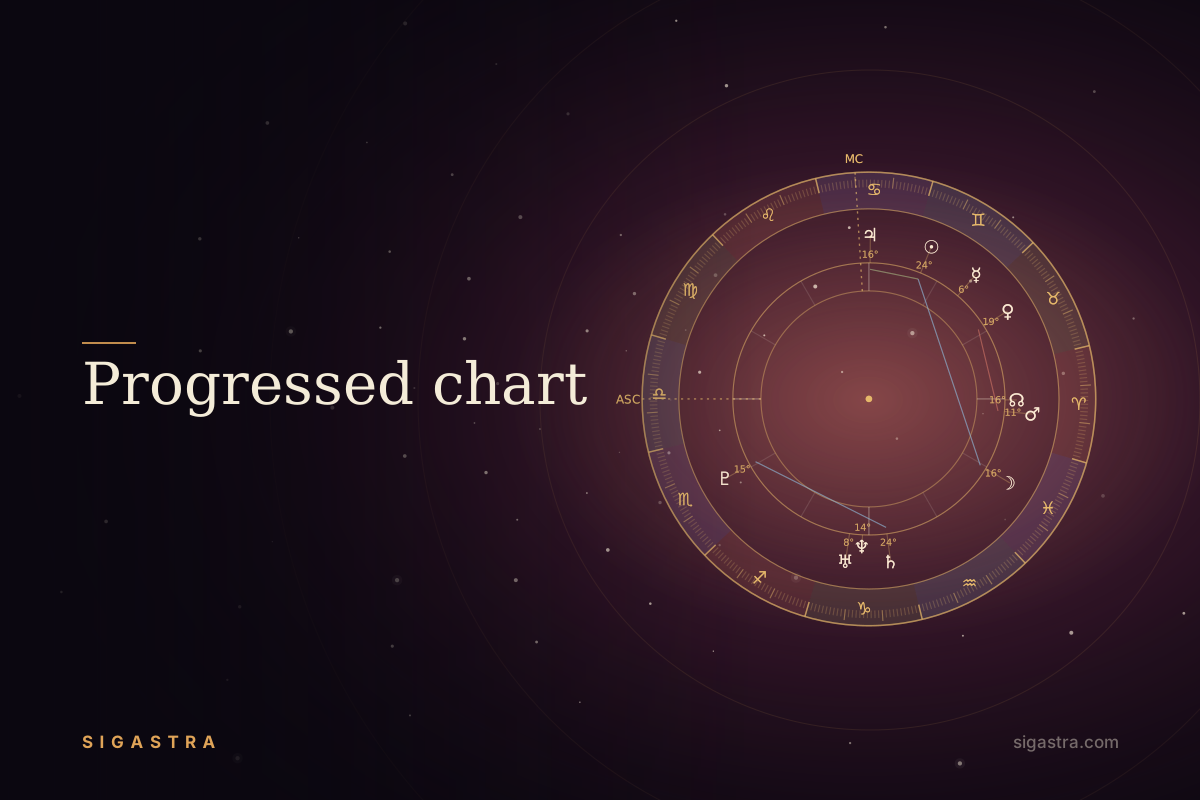
Your secondary progressed chart shows how your birth chart evolves over time — progressed Sun, Moon and planets by the day-for-a-year method, laid over your natal wheel. Free to calculate; Pro adds progressed timing and an AI interpretation.
Progressions unfold from your natal chart. Calculate your full birth chart free.
What are secondary progressions?
Secondary progressions are astrology’s day-for-a-year method: each day after your birth stands for one year of your life. So the sky one day after you were born describes your first year, two days out describes your second year, and so on. It is the most widely used way to watch a birth chart mature over a lifetime.
Unlike transits, which come from the moving sky outside you, progressions are derived entirely from your own birth chart — a slow, symbolic unfolding of the potential you were born with. The wheel above keeps your natal planets on the inner ring and lays your progressed planets over them on the outer ring.
The progressed Sun and Moon
The progressed Moon is the fastest-moving progression, changing sign roughly every two and a half years and completing a full circle of the zodiac in about twenty-seven to twenty-eight years. Its sign colours the emotional chapter you are living through — what feels nourishing, what you are drawn toward, the mood of this stretch of years.
The progressed Sun moves about one degree per year, so it changes sign roughly every thirty years. Each new sign marks a genuine shift in your evolving identity — a change in how you meet the world and what you are here to develop next. When the progressed Sun changes sign, people often feel it as the start of a new era.
How it’s calculated
To build your progressed chart, Sigastra takes your age in whole years, counts that many days forward from your exact birth moment, and computes the chart for that later date from the real ephemeris. If you are thirty-four, your progressed chart is simply the sky thirty-four days after you were born — read as a symbol of where you are now.
Because a precise birth time sharpens the Moon and the angles, an accurate time makes the progressed Moon and progressed Ascendant meaningful. Even without an exact time you can still read the progressed Sun and the slower planets.
Progressions vs transits
Progressions and transits answer different questions. Progressions unfold from within — they show how your own chart is ripening, the long inner seasons of identity and feeling. Transits come from the current sky — the actual planets overhead making contact with your natal placements right now, triggering events and timing.
Read together they are powerful: the progressed Moon tells you which emotional chapter you are in, while transits show the specific weeks that chapter’s themes come to a head. Start with your progressions here, then check your live transits to see what the sky is activating today.
Why day-for-a-year, and what the other methods do
Secondary progression is the most widely used method, and its rule is deliberately simple: one day after birth stands for one year of life. The chart for your thirtieth birthday is cast for the thirtieth day after you were born. There is no physical mechanism claimed for this and astrologers do not usually pretend otherwise — it is a symbolic correspondence that has been in use since at least the seventeenth century because practitioners found it descriptive.
There are other progression methods, and knowing they exist explains why two readings can differ. Solar arc directions move every point in the chart forward by the same amount the Sun progressed, which keeps the whole chart in one piece and produces different timing from secondary progressions. Tertiary progressions use a day for a lunar month. Primary directions, the oldest method, use the rotation of the Earth and are far more sensitive to birth time than any of the others.
Sigastra computes secondary progressions because they are the method the modern literature is written in, so what you read here lines up with what you will find elsewhere. If a source gives you a date that does not match, the first thing to check is which method it used rather than assuming one of the two is wrong.
What progressions do not do
The most common overreach is treating a progressed placement as an event. Progressions describe internal development — how the chart you were born with matures — and they are slow: the progressed Sun moves about one degree a year, which means it changes sign roughly every thirty years. That is a description of a phase of life, not of a month.
A second point that surprises people: progressions keep running when nothing visible is happening. Between two sign changes of the progressed Moon there are about two and a half quiet years, and that quiet is itself the statement. Waiting for an upheaval during such a stretch is waiting for something the progression is not announcing.
Where progressions are worth the most is in hindsight. Progressed Moon sign changes and progressed Sun sign changes frequently coincide with periods people later describe as the boundary between chapters. Checking your own past against those dates is a fair test of whether the method describes anything for you, and it costs nothing but the time to look.
It is also worth separating progressions from transits, because they are frequently confused and they answer different questions. A transit is something happening in the sky right now, measured against your birth chart. A progression is your own chart aged forward by a symbolic rule — nothing in the current sky is involved at all. That is why a progression can describe a change in you during a period when the transits are quiet, and why the two are usually read together rather than as alternatives. When a year feels significant but the transit list looks unremarkable, the progressed chart is the first place to look.
Progressed chart FAQ
What is a progressed chart?+
A progressed chart is your birth chart advanced forward in symbolic time to show how you have matured. Sigastra uses secondary progressions — the day-for-a-year method — to move your planets, then lays them over your natal chart so you can see how your chart has evolved.
What is the progressed Moon?+
The progressed Moon is the fastest progression, changing sign about every two and a half years and circling the whole zodiac in roughly twenty-seven to twenty-eight years. Its sign describes the emotional chapter you are living through right now.
How are secondary progressions calculated?+
By the day-for-a-year method: each day after your birth represents one year of life. To find your progressed chart at age N, Sigastra computes the sky N days after you were born and reads it as a picture of where you are today.
Is the progressed chart calculator free?+
Yes. Calculating your progressed chart — your progressed Sun, Moon and planets over your natal wheel — is free. Pro adds progressed timing and an AI interpretation of the inner chapter your progressions are unfolding.