Synastry Chart — Compare Two Birth Charts
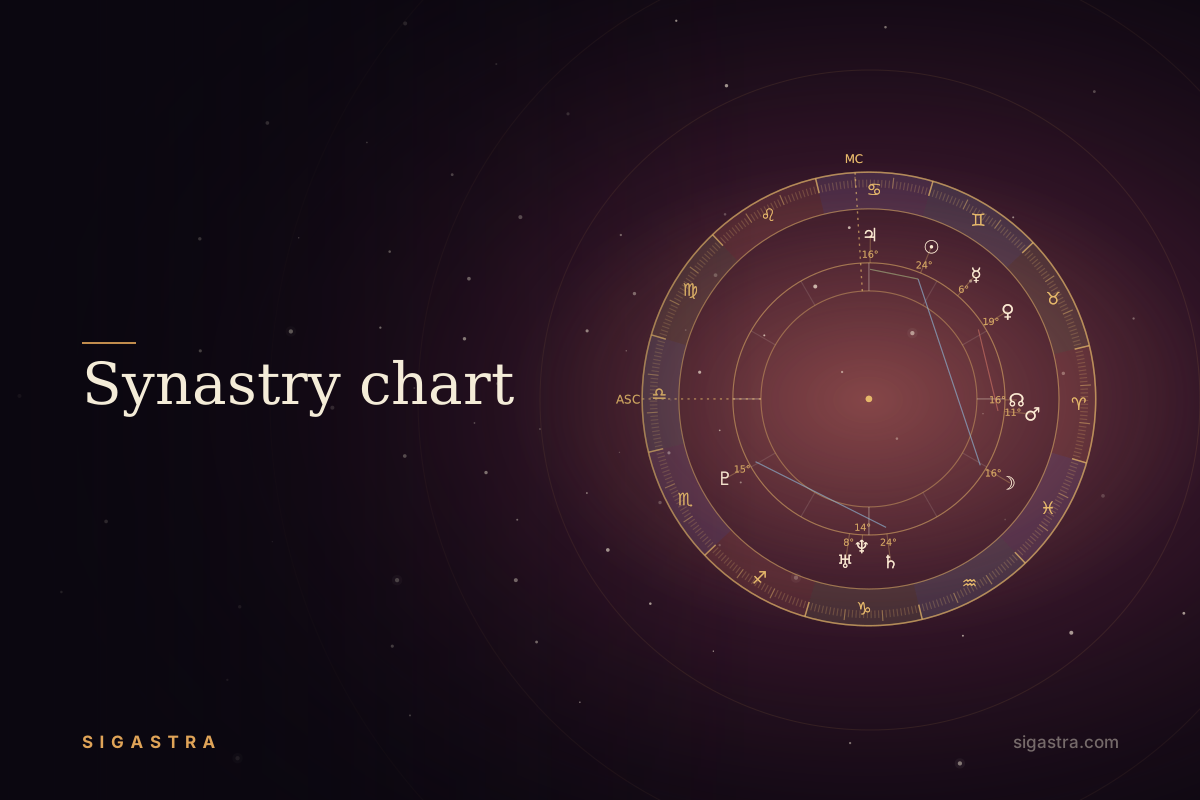
Enter two birth charts and see the real astrology between you — every inter-chart aspect on a live bi-wheel, plus a synastry score. Free to compute; Pro adds the full interpretation and the composite chart.
Your Sun, Moon and Rising shape every synastry contact. Calculate your full birth chart free.
What is a synastry chart?
A synastry chart compares two birth charts to reveal the astrological dynamics between two people. Instead of one chart, you overlay both — placing one person’s planets against the other’s — and read the angles (aspects) that form between them. Those aspects describe how you actually meet: where there’s ease and attraction, and where there’s tension to work through.
Sigastra computes each chart from the real positions of the Sun, Moon and planets with observatory-grade ephemerides, using each person’s exact birth date, time and place. The bi-wheel above is your live chart — Person A on the inner ring, Person B on the outer — with every inter-chart aspect drawn across the centre.
How to read your synastry chart
The most telling contacts are between the personal points. Sun–Moon aspects show how your core selves and emotional needs fit; Venus–Mars is the classic chemistry axis; Moon–Moon and Moon–Venus speak to emotional comfort and affection. Aspects to the Ascendant add instant recognition and physical attraction.
Harmonious aspects (trine, sextile, and many conjunctions) flow easily; hard aspects (square, opposition) create friction that can be either growth or grind. The synastry score above weighs the luminaries and tighter orbs most heavily, so it reflects the relationship’s overall grain — not a verdict.
Synastry vs composite chart
Synastry looks at two charts in dialogue — your planets touching theirs. A composite chart is different: it’s a single new chart built from the midpoints of both people’s placements, describing the relationship as its own entity, with its own Sun, Moon and Ascendant.
Both are worth reading together. Synastry tells you how you affect each other; the composite tells you what the relationship itself is like. Pro generates the composite chart alongside the interpretation, so you get both views.
Free synastry chart vs the full Pro reading
The calculator here is genuinely free: enter both charts and you get the real bi-wheel, every inter-chart aspect, the harmonious/challenging balance and the synastry score — computed, not guessed, and yours to explore as many times as you like.
Pro adds the interpretation layer: an aspect-by-aspect written reading across overview, emotional bond, communication, attraction, friction and long-term potential, plus the composite chart, saving, and PDF export. It’s the difference between the data and the story.
Why birth times matter
The Moon and the Ascendant move fast — the Moon changes sign roughly every 2.5 days and the Ascendant every ~2 hours — so an accurate birth time sharpens the most relationship-relevant points. If a time is genuinely unknown you can still run the chart (we default to noon), but the Moon and angles may shift.
For your own precise placements, calculate your full birth chart first — it computes your exact Sun, Moon and Rising from the real sky at your moment of birth.
Which contacts weigh most in a synastry reading
Contacts that run in BOTH directions weigh more than one-sided ones. If your Venus touches their Mars and their Mars touches your Venus, that is a mutual pattern; if only one side reaches across, often only one side experiences it strongly. That asymmetry explains a large share of the cases where two people describe the same relationship completely differently, and it is directly visible in the bi-wheel because you can see which ring the line starts from.
The classical weighting puts Sun, Moon, Venus, Mars and the Ascendant first, because those describe identity, emotional need, affection, desire and the way you meet each other. Contacts between outer planets are usually generational rather than personal — two people born the same year share them with everyone else born that year, so they say little about this particular pair.
House overlays are the third layer and the one most often skipped. Where their planets fall in your houses says which part of your life they occupy, and it is not symmetric: their Sun may land in your tenth house while your Sun lands in their fourth. Both are true at once, and they describe two quite different experiences of the same relationship.
What synastry cannot tell you
Synastry cannot tell you whether to stay, and any reading that says so has stopped describing the chart. What it describes is where the ease is and where the friction is, and the friction is not a prediction of failure — plenty of durable relationships are built on squares, and plenty of easy charts describe connections nobody bothered to maintain.
It also cannot compensate for a missing birth time on either side. The Moon, the Ascendant and every house overlay depend on it, and those are the placements a synastry reading leans on hardest. With one time missing you still get the planetary contacts; with both missing the reading is a fraction of what it appears to be, and it is better to know which fraction.
Finally, a synastry chart describes a pair, not a person. It says nothing about whether either of you is ready for what it describes, which is a question the individual natal charts are closer to answering. Reading the two charts separately first, then the synastry, is the order most working astrologers use for exactly that reason.
A last note on what to do with a difficult synastry chart, because the question comes up more than any other. Hard aspects between two charts describe friction with a specific subject, and knowing the subject is most of the value — a Saturn contact that keeps producing the same argument about commitment is a different problem from a Mars contact that keeps producing the same argument about pace. Neither is a reason to leave and neither resolves itself by being understood. What the chart offers is a name for the recurring conversation, which is generally more useful than being told the relationship is easy.
Synastry FAQ
Is this synastry chart calculator free?+
Yes. Entering two birth charts and seeing the bi-wheel, every inter-chart aspect, and the synastry score is completely free. Pro adds the written AI interpretation, the composite chart, saving and PDF export.
What do I need to calculate a synastry chart?+
Both people’s birth date and birthplace, and ideally the birth times. Times sharpen the Moon and Ascendant contacts; if a time is unknown the chart still runs with a noon default.
What is the synastry score?+
A 0–100 summary that weighs the aspects between the two charts, giving more weight to the Sun and Moon and to tighter orbs. It reflects the overall grain of the connection — it is a guide, not a verdict.
What is the difference between synastry and a composite chart?+
Synastry compares two separate charts (your planets against theirs). A composite chart is one new chart built from the midpoints of both, describing the relationship itself. Pro generates the composite alongside the reading.