The Moon in Astrology: Learn What It Means
If the Sun is who you are becoming, the Moon is how you feel along the way. In astrology the Moon rules your inner emotional life — your instincts, moods, comfort, and the deep needs you carry from childhood into every relationship. It is the second luminary, and many astrologers argue it reveals more about your day-to-day experience of being alive than the Sun does.
Your Moon sign describes what makes you feel safe, nourished and at home in yourself. It is the part of you that responds before you have time to think, the reflex beneath the reasoning. Because the Moon moves quickly, its exact sign depends on knowing your birth time reasonably well — Sigastra computes it precisely from real astronomy so you can read the emotional layer of your chart with confidence.
What the Moon governs
The Moon rules emotion, instinct, memory and need. Where the Sun is conscious and deliberate, the Moon is automatic and unguarded — it is your gut reaction, the mood that arrives uninvited, the craving for a particular kind of comfort. It describes how you self-soothe, what makes you feel held, and the emotional atmosphere you reach for when you are tired or under pressure.
This is also the planet of home, family and roots. The Moon carries the imprint of your earliest experiences of care, and it colours how you nurture others and how you like to be nurtured in return. In a birth chart it often points to your relationship with mother figures and with the idea of belonging. None of this is fixed fate — it is a description of your emotional wiring that you can come to understand and work with.
The Moon is the natural ruler of Cancer and is exalted in Taurus, both signs that value emotional security and physical comfort. It governs the fourth house of home, family and inner foundations. Its cycle also gives us the lunar phases and, symbolically, our sense of emotional rhythm — the natural rise and fall of feeling that everyone experiences.
The Moon through the signs
The Moon is the fastest-moving body in the chart. It changes zodiac sign roughly every two and a half days and completes the whole circle in about a month, which is why so much attention is paid to knowing an accurate birth time. The sign it occupies describes the flavour of your emotional needs — what soothes you, what unsettles you, and how you instinctively react.
A few examples show the range. A Moon in Cancer, in its home sign, feels deeply and needs closeness, safety and a sense of being emotionally cared for. A Moon in Aries reacts fast and hot, needing independence and direct action to feel settled, and cooling down as quickly as it flares. A Moon in Capricorn keeps feelings contained and controlled, finding security in competence and self-reliance rather than open displays. A Moon in Pisces is porous and compassionate, absorbing the moods around it and needing quiet, beauty or solitude to recover.
Your Moon sign often explains reactions that surprise even you — the sudden need to withdraw, the specific thing that makes you feel loved, the comfort you return to again and again. Reading it can be quietly liberating, because it names patterns you may have judged in yourself as simply the shape of your emotional nature.
- Moon in Cancer
- The Moon’s home sign — deeply feeling, protective, needs closeness and emotional safety.
- Moon in Aries
- Fast, fiery reactions — needs independence and directness; feelings flare and pass quickly.
- Moon in Libra
- Needs harmony, fairness and companionship — unsettled by conflict and imbalance.
- Moon in Capricorn
- Contained and self-reliant — feels safe through competence, structure and control.
- Moon in Pisces
- Porous and compassionate — absorbs surrounding moods; needs quiet and beauty to recharge.
The Moon through the houses
The house your Moon occupies shows the area of life where you are most emotionally invested and where your sense of security is most at stake. It is where you seek comfort, where you can be moody or protective, and where your feelings run closest to the surface.
A Moon in the fourth house — its natural home — anchors emotional life in family, home and private space; these people need a safe base to return to and feel deeply tied to their roots. A Moon in the seventh house channels emotional need into partnership, seeking security through a close one-to-one bond and reading the moods of others acutely. A Moon in the tenth house makes career and public life emotionally charged, so recognition and vocation feel personal rather than merely practical. A Moon in the twelfth house keeps emotional life private and interior, often more comfortable feeling things alone than displaying them.
Because the Moon is so responsive, its house is usually where your inner weather is most changeable. Understanding it helps you see why certain life areas move you so much more than they seem to move other people — and where you most need to build a genuine sense of safety.
Mythology, symbolism and astronomy
The Moon has been linked to goddesses of night, tides and cycles across countless traditions. In Greek and Roman myth it is associated with Selene and Luna, who drove the moon across the night sky, and with Artemis or Diana, goddess of the wild, the hunt and protection. The recurring themes are receptivity, instinct, nurture and the mysterious rhythm of things that wax and wane.
The Moon’s glyph is ☽ — a crescent, the simplest possible picture of the changing lunar shape. Where the Sun’s glyph is a whole circle, the crescent is open and receptive, a cup that fills and empties. It captures the Moon’s nature exactly: reflective rather than radiant, shaped by what it receives, always in motion between fullness and emptiness.
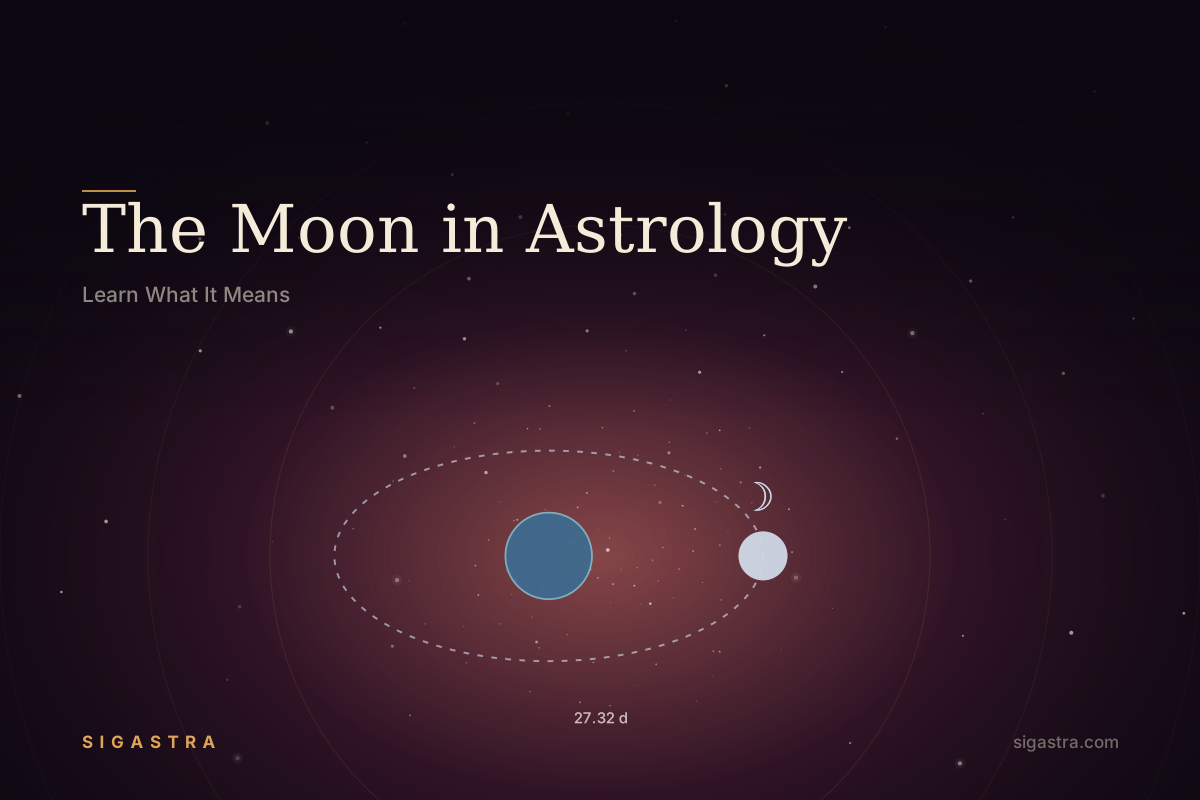
Astronomically, the Moon is Earth’s only natural satellite, and unlike a planet it circles the Earth rather than the Sun. It completes its orbit in about a month, which is why it moves so fast against the zodiac — roughly one sign every two and a half days. Its light is reflected sunlight, a detail astrologers find symbolically fitting: the Moon shows how we reflect, absorb and respond to the world rather than how we generate our own light.
The Moon’s phases and your emotional rhythm
The Moon is the one body whose changing appearance everyone can watch, and its cycle from new to full and back has always been a symbol of emotional and creative rhythm. The phase the Moon was in when you were born — the relationship between your Sun and Moon — adds another layer to the reading: a new-moon birth tends toward instinctive, self-starting energy, while a full-moon birth often carries a strong awareness of others and of contrast within.
Day to day, the Moon’s current position through the sky is the fastest-changing influence astrologers track, which is why lunar rhythm is used for reflection on mood and timing. It’s worth holding this lightly. Sigastra computes these positions from real astronomy, and they make a rich mirror for noticing your own emotional patterns — not a mechanism that controls your feelings or predicts them in advance.
How to work with your Moon
Working with your Moon begins with giving your emotional needs the same respect you’d give a friend’s. Once you know your Moon sign, you can build in the specific kind of comfort it asks for — solitude and beauty for a Pisces Moon, structure and small wins for a Capricorn Moon, closeness and reassurance for a Cancer Moon — rather than judging yourself for needing it.
The Moon also teaches emotional honesty. Because it reacts before thought, learning to notice your first instinctive response, name it, and then choose what to do with it is one of the most useful practices a chart can point you toward. Astrology here is a tool for self-understanding and reflection, offered as a mirror rather than a diagnosis — it is never a replacement for professional support with your mental or physical health.
Continue learning
Frequently asked
How is the Moon sign different from the Sun sign?+
Your Sun sign is your conscious identity and life purpose; your Moon sign is your emotional nature — what you feel, need and instinctively reach for to feel safe. The Sun is who you’re becoming; the Moon is how you experience being alive day to day.
Why do I need my birth time for my Moon sign?+
The Moon moves fast, changing sign roughly every two and a half days, so on some birth dates it switches signs partway through the day. A reasonably accurate birth time ensures the calculated Moon sign is correct rather than the one on either side of the boundary.
What does my Moon sign actually tell me?+
It describes your emotional needs and instincts — how you self-soothe, what makes you feel secure and cared for, how you nurture others, and your gut reactions. It often explains emotional patterns that your Sun sign alone can’t account for.
Which sign and house does the Moon rule?+
The Moon rules Cancer and is the natural ruler of the fourth house of home, family and inner foundations. It is also exalted in Taurus, a sign that shares its love of comfort, stability and emotional security.
Does the full Moon really affect my mood?+
Astrology uses the lunar cycle as a symbol of emotional rhythm and a prompt for reflection, and many people notice patterns in how they feel across the month. Sigastra treats this as a mirror for self-awareness, not a proven mechanism that controls emotions.
Calculate your real birth chart free — every planet, sign and house computed from exact astronomy.
Calculate my birth chart