Learn Astrology: A Clear, Real-Astronomy Guide
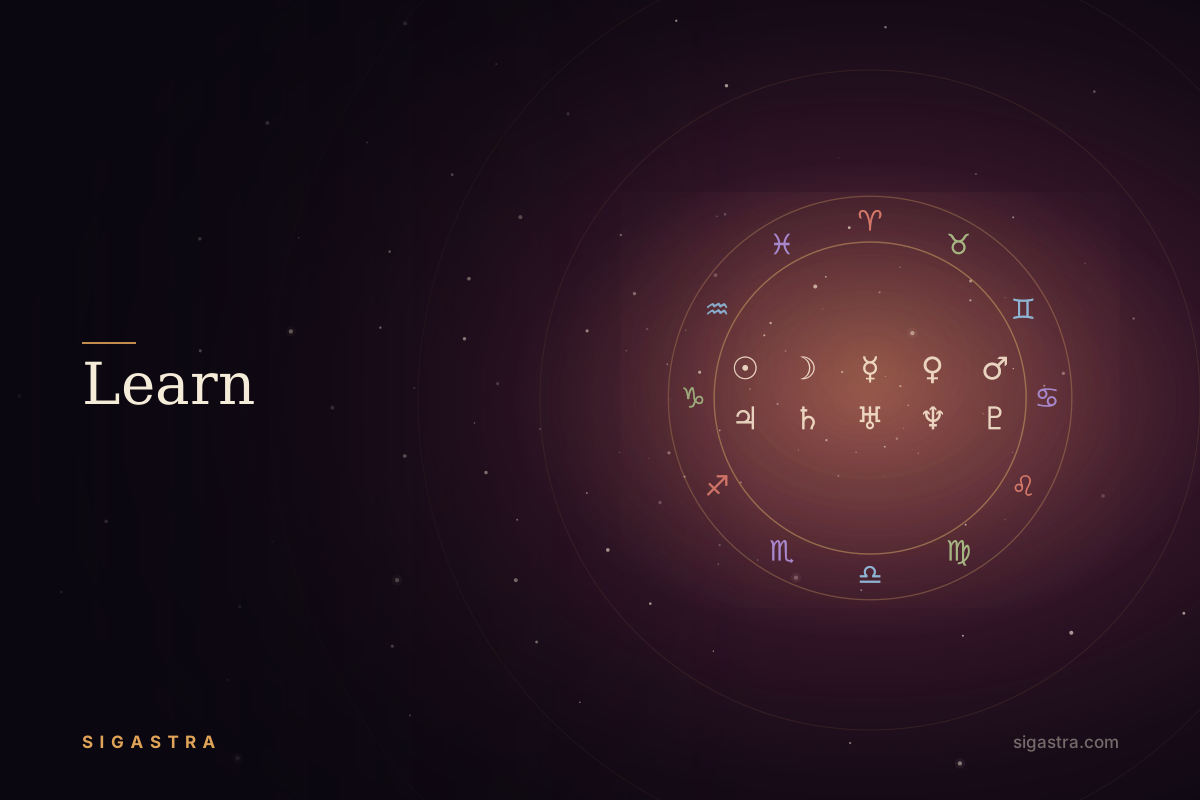
Astrology is one of the oldest ways humans have tried to make sense of themselves and their place in time. This guide teaches it from the ground up — clearly, honestly, and grounded in real astronomy rather than vague clichés. Whether you have only ever read a Sun-sign horoscope or you are ready to understand a full birth chart, start here and follow the thread.
Every explanation on Sigastra rests on the same foundation: your chart is computed from the actual positions of the Sun, Moon and planets at the exact moment and place you were born, using the same observatory-grade ephemerides professional astrologers rely on. We treat astrology as a language for reflection and self-knowledge — not fortune-telling, and never a substitute for medical, financial or legal advice.
Core concepts
The building blocks — start here and read in order.
The zodiac signs
Evergreen personality profiles for all twelve signs — traits, love, work and compatibility.
The planets
What each planet means, through the signs and houses, with its mythology.
How to use this guide
Astrology has a small number of moving parts that combine into something rich. There are the planets (including the Sun and Moon), which describe what is happening — identity, emotion, communication, love, drive. There are the twelve signs, which describe how each planet expresses itself. There are the twelve houses, which describe where in life it plays out. And there are the aspects, the angles between planets, which describe how the parts of you talk to one another.
If you are brand new, read the concept pages in order: begin with what astrology actually is, then the birth chart as a whole, then your Sun, Moon and Rising — the "big three" that sketch the fastest, truest outline of a person. From there, the houses, aspects and transits pages show how the chart deepens and how it moves over time. The planet pages can be read in any order, whenever you want to go deeper on one part of yourself.
Start with your own chart
Reading about astrology in the abstract only takes you so far. The moment it becomes genuinely useful is when you see it in your own chart — your real Sun, Moon and Rising, your planets in their actual signs and houses, the specific aspects that shape how you operate. Everything in this guide is designed to be read alongside your own map of the sky.
You can calculate that map for free in under a minute. Because the Rising sign and houses depend on your exact birth time, entering an accurate time unlocks the most personal layers of the chart. If you know it, use it; if you do not, you still get an accurate reading of every planet by sign.
The four building blocks, in one glance
Almost everything in a birth chart is a combination of just four kinds of thing. Once you can name them, the rest of astrology stops feeling like a wall of jargon and starts reading like a language with a simple grammar. Keep this short glossary in mind as you move through the guide — every concept and planet page below is really just exploring one of these four in depth.
The planets (including the Sun and Moon) are the actors; the signs are the costumes and accents they wear; the houses are the stages they perform on; and the aspects are the conversations they have with one another. A single placement — say, "Venus in Libra in the seventh house, trine the Moon" — is all four at once: a planet, in a sign, in a house, in aspect. Learn to read that sentence and you can read a chart.
- Planets — what
- The Sun, Moon and planets are the drives at work in you: identity, emotion, mind, love, will, growth, discipline and change.
- Signs — how
- The twelve zodiac signs colour the style and tone through which each planet expresses itself — bold, cautious, curious, tender, and so on.
- Houses — where
- The twelve houses are the areas of life a planet plays out in: self, money, communication, home, love, work, partnership and more.
- Aspects — how they relate
- The angles between planets — harmonious or tense — describe how the different parts of you cooperate or pull against each other.
Astrology, honestly
We think you deserve the truth about what astrology is and is not. The astronomy is exact and verifiable — the planetary positions in your chart are real, calculated to the arc-second. The interpretation layered on top is a symbolic tradition thousands of years old, meant for insight and self-reflection, not scientific prediction. Held that way, it is a remarkably useful mirror: a vocabulary for noticing patterns, naming tendencies, and thinking about timing and growth.
Throughout this guide we keep those two layers distinct — what we compute versus what we interpret — so you always know which is which. That honesty is the whole point of Sigastra.
From your Sun sign to your whole chart
Most people meet astrology through their Sun sign — the "star sign" you get from your birthday alone. It is real and it matters, but it is genuinely only one twelfth of the picture. Your Sun describes your core identity; your Moon describes your inner emotional world; your Rising sign describes how you come across and frames the entire chart. Add the other planets, the houses they fall in and the aspects between them, and you move from a single label to a detailed portrait that actually sounds like you.
That is the journey this guide is built for. Start with the concepts that give you the map, read the planets to understand each part of yourself, and return to your own chart at every step. You do not need to memorise anything — you need only follow your curiosity, one page at a time, and let the picture fill in.
Calculate your real birth chart free — then bring every concept here back to your own sky.
Calculate my birth chartFrequently asked
Where should a complete beginner start?+
Read "What Is Astrology?" first, then "What Is a Birth Chart?", then your Sun, Moon and Rising sign pages. Those five give you the core vocabulary; everything else builds on them.
Do I need to believe in astrology to learn it?+
Not at all. You can approach astrology as a symbolic language and a tool for reflection without treating it as science or prediction. This guide is written to be useful either way, and is always honest about the difference between the astronomy we compute and the meaning we interpret.
Is any of this a substitute for professional advice?+
No. Astrology is for insight, reflection and entertainment. It is never a replacement for medical, psychological, financial or legal advice from a qualified professional.
What makes Sigastra different from a horoscope app?+
Every chart is computed from real astronomy — the observatory-grade ephemerides and the correct historical time zone for your birthplace — rather than guessed from your Sun sign. You get your actual sky, then plain-language interpretation on top.