The Astrological Houses: Twelve Areas of Life
If the zodiac signs describe how the planets in your chart behave, the twelve houses describe where they do their work. Each house is a slice of the birth-chart wheel that governs a specific arena of life — identity, money, relationships, career, and so on — so knowing which house a planet falls into tells you which part of your life it colours most strongly.
The houses are built from your Ascendant, which means they depend entirely on your exact birth time and place. Get the time right and the houses lock a planet into a precise life area; get it wrong and the whole framework can shift. That is why the house layer is the most powerful, and the most time-sensitive, part of reading a chart.
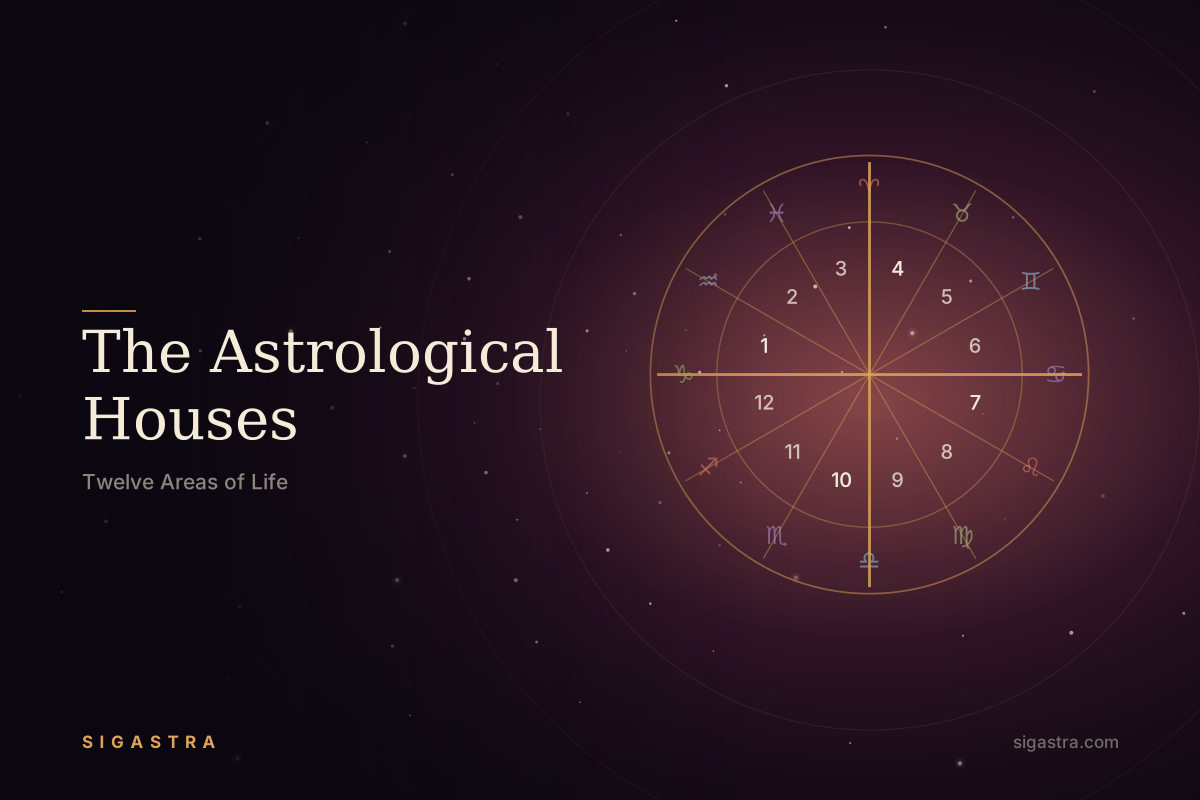
What a house is and where it comes from
The birth chart is a 360-degree circle divided two ways at once. The twelve signs form the outer ring and set the tone of each planet; the twelve houses form the inner slices and set the setting. A planet always sits in one sign and one house simultaneously — the sign is the how, the house is the where.
The houses begin from the Ascendant, the point rising on the eastern horizon at your birth. That degree becomes the cusp of the first house, and the wheel is then divided into twelve sectors from there. Because the Ascendant moves about one degree every four minutes, the entire house structure hinges on an accurate birth time and the correct birthplace coordinates.
There is more than one method for slicing the wheel — house systems such as Placidus, Whole Sign, and Koch divide the sky by slightly different rules, so a planet can occasionally land in neighbouring houses depending on the system. Sigastra computes the cusps from real astronomy and your exact data, so the map you read rests on sound mathematics before any interpretation begins.
The twelve houses at a glance
Here is a compact tour of all twelve. Read each as a domain of experience rather than a fixed prediction: whichever planets fall in a house show where that part of life tends to draw your energy and attention.
- 1st House — Self
- Identity, appearance, first impressions, and the way you begin things. It starts at your Ascendant and sets the tone for the whole chart.
- 2nd House — Money & Values
- Income, possessions, self-worth, and the resources you build. What you own and what you consider truly valuable.
- 3rd House — Communication
- Thinking, speaking, writing, siblings, and short journeys. The everyday mind and how you exchange information.
- 4th House — Home & Roots
- Family, ancestry, home life, and your private foundations. Where you come from and where you feel safe.
- 5th House — Creativity & Play
- Romance, self-expression, children, pleasure, and creative risk. The joyful, spontaneous part of life.
- 6th House — Work & Health
- Daily routines, service, habits, and wellbeing. The practical maintenance of body and working life.
- 7th House — Partnership
- One-to-one relationships, marriage, close business partners, and open rivals. The mirror of the other person.
- 8th House — Depth & Shared Resources
- Intimacy, transformation, shared money, inheritance, and taboo. What we merge and what we let go of.
- 9th House — Meaning & Horizons
- Higher learning, philosophy, travel, faith, and the big questions. The search for a wider view.
- 10th House — Career & Reputation
- Vocation, public standing, ambition, and legacy. How the world sees your work and status.
- 11th House — Community & Hopes
- Friendships, networks, groups, and long-range goals. The future you build alongside other people.
- 12th House — The Unconscious
- Solitude, dreams, the hidden, endings, and what lies beneath awareness. The most private house of all.
Angular, succedent, and cadent houses
The twelve houses fall into three groups of four that describe how a planet's energy tends to express itself. The angular houses — first, fourth, seventh, and tenth — sit on the four cardinal points of the chart and carry the most force; planets here tend to act, initiate, and show up prominently in your life.
The succedent houses — second, fifth, eighth, and eleventh — follow the angular ones and deal with resources, stability, and consolidation. Planets here work to hold and build what has been started. The cadent houses — third, sixth, ninth, and twelfth — come last in each quarter and govern learning, adaptation, and processing; planets here often work through thought, service, and reflection rather than bold action.
You do not need to memorise these categories to read a chart, but they add nuance. An empty house is not a problem, either — with only ten major bodies and twelve houses, some houses are naturally unoccupied, and their affairs are simply read through the sign on the cusp and its ruling planet.
Reading planets in houses
The core skill is combining three pieces of information: the planet, the sign it is in, and the house it occupies. The planet is the what — Venus is love and value, Mars is drive and assertion. The sign is the how — the style and tone. The house is the where — the arena of life the planet operates in. Venus in a bold sign in the tenth house reads very differently from the same Venus in the fourth.
Ruling planets add another layer. Each house cusp carries a sign, and that sign's ruling planet becomes the steward of the house's affairs. To understand a house that has no planets in it, follow its ruler: find where that planet lives by sign and house, and you learn how that area of life tends to unfold.
The houses that hold your Sun, Moon, and Ascendant ruler usually carry the most personal weight. Start there when you read your own chart, because those placements point to the life areas where your identity, feelings, and outward style are most invested.
One more habit sharpens a house reading. When several planets pile into a single house, that area of life becomes a dominant preoccupation, often a place where you invest disproportionate energy and where much of your growth plays out. Conversely, an emphasis spread evenly around the wheel describes a life that draws on many arenas at once. Neither is better; the pattern simply tells you where your chart concentrates its attention.
Why the houses reward an exact birth time
Everything about the house layer depends on the Ascendant, and the Ascendant depends on the minute of birth. Because it moves so quickly, an error of even fifteen or twenty minutes can slide a planet from one house into the next, which changes the life area it speaks to. This is the single biggest reason astrologers press so hard for an accurate time.
If you have your exact time, the house reading becomes specific and rewarding — you can see precisely where each planet concentrates. If your time is rounded or uncertain, read the houses as provisional and lean more on the planetary sign positions, which do not depend on the time in the same way.
Sigastra treats the houses as a tool for reflection and self-knowledge, not as fate. They show where your energy tends to gather so you can think about it honestly — never as deterministic prediction or as guidance on medical, financial, or legal decisions.
The natural houses and how to remember them
Beginners often find the houses easier to learn through their so-called natural rulers. Astrology pairs each house with the sign and planet that share its themes: the first house echoes Aries and Mars, the second echoes Taurus and Venus, the third echoes Gemini and Mercury, and so on around the wheel to the twelfth, which echoes Pisces and Neptune. This mirroring is a teaching device, not a fixed feature of your chart, but it makes the meaning of each house click into place.
Notice the rhythm of opposite houses, too. Each house sits across from its partner and the pair works as a theme and counter-theme. The first house of self faces the seventh house of partnership; the second house of your own resources faces the eighth of shared resources; the fourth house of private roots faces the tenth of public standing. Reading houses in these opposing pairs often reveals a balance you are learning to strike.
None of this replaces looking at your actual chart. Your real houses carry whatever signs your birth time places on their cusps, which may differ from the natural pattern entirely. The natural houses are simply scaffolding — a way to hold twelve life areas in your head until the specifics of your own wheel become familiar.
A final practical note: the houses are best learned slowly, one quarter of the wheel at a time. The first four houses build the private foundations of a life — self, resources, mind, and home. The middle four, from the fifth to the eighth, turn outward toward creativity, work, partnership, and depth. The last four, from the ninth to the twelfth, reach for meaning, vocation, community, and the unconscious. Reading the wheel as a journey from the personal to the collective gives the twelve houses a coherent shape rather than twelve isolated labels to memorise, and it makes your own chart far easier to interpret in one sitting.
Continue learning
Frequently asked
What is the difference between a sign and a house?+
A sign describes how a planet expresses itself, while a house describes where in life it acts. Every planet sits in one sign and one house at once, so you read the two together for a full picture.
Why do the houses depend on my birth time?+
The houses are built from your Ascendant, which moves about one degree every four minutes. A small error in birth time can shift a planet into a neighbouring house and change the life area it governs.
What does it mean if a house is empty?+
An empty house is completely normal, since there are only ten major bodies and twelve houses. You read its affairs through the sign on its cusp and the planet that rules that sign.
Which houses matter most in a chart?+
The angular houses — first, fourth, seventh, and tenth — tend to carry the most force. The houses holding your Sun, Moon, and chart ruler are usually the most personally significant.
Do different house systems give different results?+
Sometimes. Systems like Placidus, Whole Sign, and Koch divide the wheel by different rules, so a planet near a cusp can fall in different houses. The sign positions of your planets stay the same across systems.
Calculate your real birth chart free — every planet, sign and house computed from exact astronomy.
Calculate my birth chart