What Is My Astrology Birth Chart?
A birth chart, also called a natal chart, is a map of the sky as it looked from your exact birthplace at the exact moment you were born. Astrology treats that single frozen instant as a kind of personal snapshot: the Sun sat in one zodiac sign, the Moon in another, and every planet occupied its own precise degree of the 360-degree circle around you. A chart calculator simply turns your birth date, time and place into that map.
If a Sun sign is one word about you, a birth chart is the whole paragraph. It is the difference between knowing you are, say, a summer-born person and having a detailed portrait of the entire sky above your cradle. Understanding how a chart is built, and why the birth time matters so much, is the key that unlocks everything else in astrology.
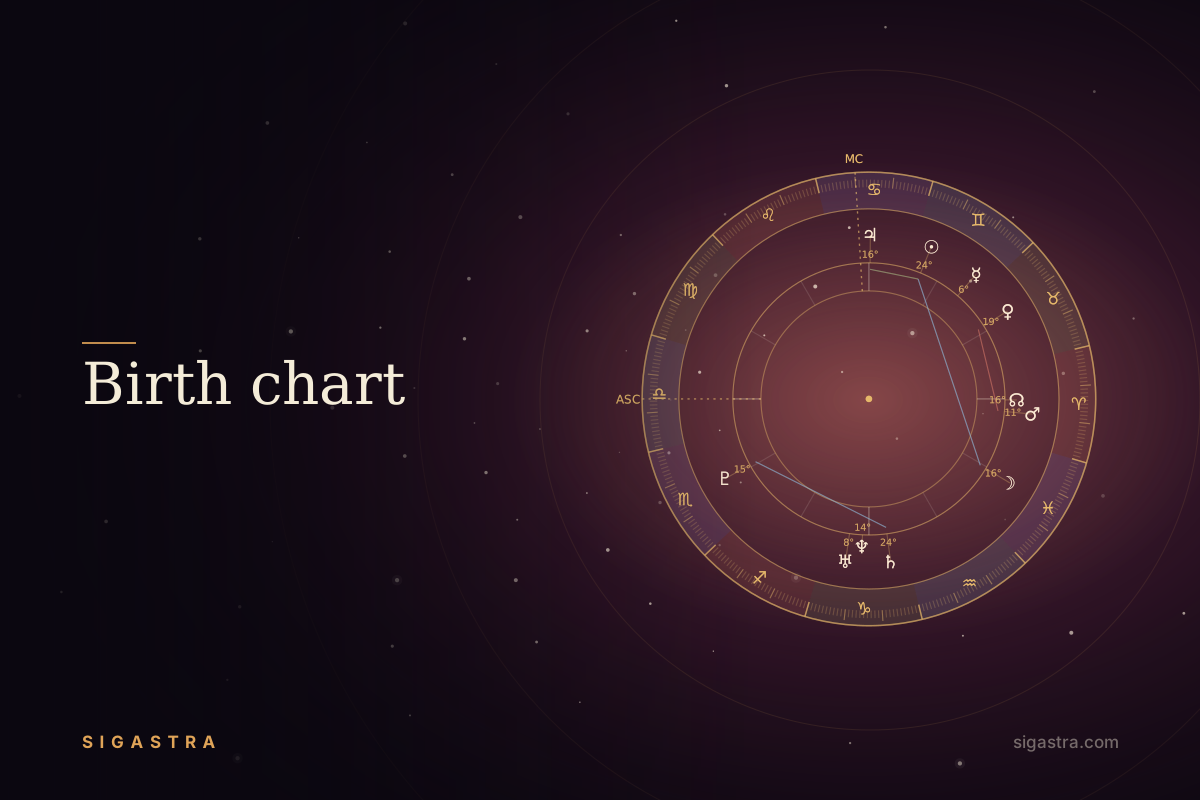
The chart is a real snapshot of the sky
Imagine standing at your birthplace at the minute you were born and taking a 360-degree photograph of the whole sky, including the half hidden below the horizon. A birth chart is the astrological version of that photograph, flattened into a wheel. Everything in it is drawn from genuine astronomy: the same positional data used by observatories and navigation systems.
The wheel is read as a circle of twelve zodiac signs around the outside, with the planets placed wherever they actually were. Because the Earth turns and the planets move, that arrangement is different from one moment to the next, which is what makes each chart specific. No invention is involved in the placements themselves; the mathematics is exact, and astrology then supplies the meaning laid over the top.
This is why astrologers insist that a chart is personal. Change the moment even slightly and some of the fast-moving points shift. The chart is not a generic template assigned by month; it is a description of your particular sky, which is part of why it can feel more specific than a one-line horoscope ever could.
Planets: the what
The planets are the actors in your chart. Each one represents a different drive or function in a human life, and none of them alone is you; the whole cast together is. Reading a chart begins with knowing what each body is responsible for.
The Sun is your core identity and sense of purpose, and the Moon is your emotional inner world and instincts. Mercury governs how you think and communicate, Venus how you love and what you value, and Mars how you act and assert yourself. The slower bodies, Jupiter and Saturn, deal with growth and discipline, while Uranus, Neptune and Pluto describe deeper, generational themes.
When you read that a planet is in a particular sign, you are combining two ideas: what the planet does and the style in which it does it. That single sentence structure, this planet expressed in this way, is the grammar of the entire chart.
- Sun
- Core identity, vitality and the sense of purpose you are growing into.
- Moon
- Emotions, instincts and what makes you feel safe and cared for.
- Mercury, Venus, Mars
- The personal planets of mind, love and drive that shape daily life.
- Jupiter and Saturn
- Growth and expansion on one hand, structure and discipline on the other.
Signs versus houses
Beginners often confuse signs and houses, but the distinction is simple and important. The twelve zodiac signs describe the how: the tone, style and flavour a planet takes on. The twelve houses describe the where: the concrete area of life in which that planet plays out, from home and family to career and partnership.
Think of it this way. A planet in a sign tells you the manner of an action, and the same planet in a house tells you the arena. Venus in a particular sign hints at how you love; Venus in a particular house hints at where love and value show up, such as in your work, your home or your friendships. You need both to get a full reading.
Crucially, the houses depend on your exact birth time, while the signs the planets occupy mostly do not. That single fact is the reason time is treated so seriously in astrology, and it is what the next section is about.
Aspects: how the parts talk to each other
A chart is not just a list of placements; it is a web of relationships. Aspects are the geometric angles the planets form with one another around the wheel, and they describe how the different parts of you cooperate, support or clash. They are the difference between a cast of characters standing in separate rooms and a cast actually holding a conversation.
Some aspects feel easy and flowing, suggesting talents that come naturally, while others feel tense and demanding, marking the friction points where growth tends to happen. Neither is simply good or bad. A challenging aspect often describes exactly the area where a person is most driven, most tested and, in time, most capable.
You do not need to master aspects to benefit from your chart, but knowing they exist explains why astrologers rarely read a single placement in isolation. The meaning of any one planet is shaded by the conversations it is having with the others.
Why your exact birth time matters
Most free horoscopes need only your birth date, because the Sun moves slowly and stays in one sign for about a month. But the two most personal layers of a chart, your Rising sign and your house positions, depend on the time of birth, and they move fast. The Rising sign travels through the entire zodiac every twenty-four hours, roughly one degree every four minutes.
That speed changes everything. Two people born in the same city on the same day, a couple of hours apart, can share every planetary sign yet have different Rising signs and a different house for every planet, producing noticeably different readings. If you know your birth time to the minute, use it, because the chart it produces is far richer and more specific to you.
If you do not know your exact time, you are not shut out. You still get an accurate reading of every planet by sign, which is the bulk of the chart. Only the time-sensitive layers, the Rising sign and the houses, are set aside until you can find your time, often on a birth certificate or hospital record.
How to start reading your chart
A full chart can look overwhelming at first, a wheel crowded with symbols and lines, but you can read it in a sensible order. Begin with the big three: your Sun for identity, your Moon for emotional needs and your Rising sign for outward manner. Those three alone give a surprisingly complete first sketch and are the natural place for any beginner to start.
From there, work outward one planet at a time. For each, ask the same two simple questions: what does this planet govern, and what sign and house is it in? That gives you the function, the style and the arena in a single sentence, such as how you communicate showing up in your work, or how you love showing up at home. Building the picture placement by placement keeps it manageable.
Only once the individual pieces make sense is it worth looking at the aspects between them, the lines across the middle of the wheel that show how the parts interact. Read the chart as a whole rather than hunting for a single verdict; the art of astrology lies in weaving the placements together into a coherent portrait, not in isolating one line and treating it as fate.
Continue learning
Frequently asked
What is the difference between a birth chart and a natal chart?+
There is no difference. Birth chart, natal chart and horoscope in its original sense all refer to the same thing: the map of the sky at your exact moment and place of birth. The terms are used interchangeably.
Do I need my exact birth time?+
For the full chart, yes, because your Rising sign and houses depend on it and move very fast. Without a time you still get an accurate reading of every planet by sign; only the time-sensitive layers are left out until you find it.
What if I do not know my birth time at all?+
You can still build a meaningful chart from your date and place, covering all the planetary signs. Many people check a birth certificate or hospital record to recover the time later, at which point the Rising sign and houses can be added.
How many planets are in a birth chart?+
A typical chart includes the Sun and Moon plus Mercury, Venus, Mars, Jupiter, Saturn, Uranus, Neptune and Pluto, along with key points like the Ascendant. Astrology counts the Sun and Moon among the bodies even though astronomically they are not planets.
Is a birth chart based on real astronomy?+
Yes. The positions come from genuine astronomical data, the same used by observatories and navigation software. Sigastra computes them with the observatory-grade ephemerides and correct time-zone handling; the astrology is the meaning layered over accurate placements.
Calculate your real birth chart free — every planet, sign and house computed from exact astronomy.
Calculate my birth chart