What Is My Rising Sign in Astrology?
Your rising sign, also called the Ascendant, is the zodiac sign that was climbing over the eastern horizon at the exact moment and place you were born. If the Sun sign is the core of who you are and the Moon sign is your inner emotional weather, the rising sign is the doorway between the two — the first impression you make, the instinctive way you meet a new room, and the lens through which the rest of your chart reaches the world.
Unlike your Sun sign, which most people can find from their birth date alone, the Ascendant demands precision. It moves roughly one degree every four minutes and cycles through all twelve signs in a single day, so a difference of an hour or two can hand you an entirely different rising sign. That is why any honest reading of your Ascendant begins with your exact birth time.
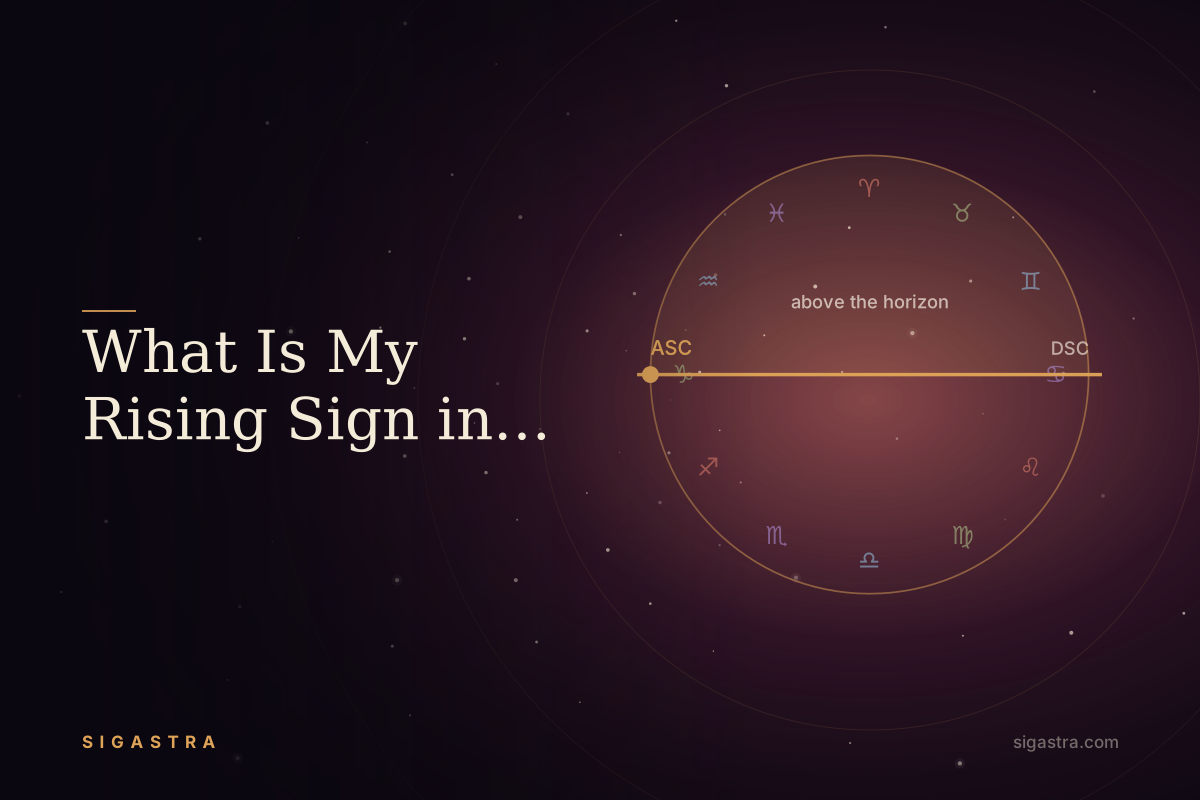
What the Ascendant actually is, astronomically
Picture the sky as a great circle wrapped around the Earth, with the band of the zodiac running through it. As the planet turns on its axis once a day, that entire band appears to rise in the east and set in the west, just as the Sun does. The Ascendant is simply the precise point of the zodiac that is rising — crossing the eastern horizon — at your birth moment, seen from your birthplace. Whatever sign occupies that point becomes your rising sign.
Because the whole zodiac wheels past the horizon every twenty-four hours, each of the twelve signs takes its turn on the eastern edge for roughly two hours. The exact durations vary a little by sign and by how far north or south you were born, but the headline is speed: the Ascendant is the fastest-moving point in your chart. This is what separates it so sharply from the slow, month-long march of the Sun through a sign.
Sigastra derives your Ascendant the same way an observatory would fix a star's position — from real ephemeris data, your coordinates, and the time zone in force on your birth date. The mathematics is astronomical, not mystical; astrology then supplies the meaning laid over an accurately computed point.
Why exact birth time is non-negotiable
Two babies born in the same hospital on the same morning, ninety minutes apart, can share a Sun sign, a Moon sign, and nearly identical planetary positions — yet carry different rising signs. When the Ascendant shifts, so does the entire framework of houses built from it, which means every planet can land in a different life area. A small error in birth time quietly reshapes a large part of the reading.
This sensitivity cuts both ways. If you know your time to the minute, your chart becomes far richer and more specific. If your time is rounded to the nearest hour, or recorded only as “morning,” treat the Ascendant and house placements as approximate rather than certain. Many people track down the precise figure on a birth certificate or hospital record, and it is worth the effort.
If you truly cannot find your birth time, the rest of the chart still holds. Your planetary sign positions remain accurate, and you can read those with confidence. Only the time-sensitive layers — the Ascendant and the houses — wait until the exact minute surfaces.
Rising sign versus Sun sign versus Moon sign
It helps to think of the big three as a team with distinct jobs. The Sun sign is your core identity and the thread of purpose you are growing toward. The Moon sign is your private inner life — how you feel, soothe yourself, and respond before you have had time to think. The rising sign is the interface: the manner, pace, and appearance you lead with, often before anyone learns what lies underneath.
This is why people are frequently “mistyped” by others. Someone with a bold, direct Ascendant may read as fiery and forward even if their Sun and Moon are quiet and reflective. The rising sign is genuinely the first thing the world meets, so it shapes reputation and initial chemistry far more than the Sun sign alone.
None of these three overrides the others. A satisfying self-portrait comes from reading them together — identity, inner life, and outward style as a single conversation rather than three competing labels.
The Ascendant and the shape of your chart
The Ascendant does more than describe first impressions; it sets the foundation of the whole wheel. The exact degree of your rising sign becomes the cusp of your first house, and from there the other eleven houses are drawn in sequence. Change the Ascendant and you redraw the map of where every planet does its work — in relationships, career, money, home, and so on.
The planet that rules your rising sign, often called the chart ruler, takes on special weight because of this. If your Ascendant is in Libra, for instance, Venus becomes a lead actor in your story, and wherever Venus sits by sign and house colours how your outward style expresses itself. Following the chart ruler is one of the most useful habits a beginner can build.
Any planet sitting close to the Ascendant is amplified too. A planet near that eastern point tends to broadcast loudly through your personality and physical presence, sometimes more visibly than your Sun. This is another reason the rising sign rewards a precise birth time: these fine-grained effects hinge on getting the degree right.
How to read your rising sign well
Start by finding the sign itself, then read it as a style of engagement rather than a fixed personality verdict. Ask what tempo, what tone, and what priorities that sign brings to a first encounter. A cardinal rising tends to initiate; a fixed rising tends to hold steady; a mutable rising tends to adapt. These textures show up in body language, wardrobe instincts, and the way you enter a conversation.
Next, locate your chart ruler and note its sign and house, because that placement tells you where your outward manner is really pointed. Someone with an adventurous Ascendant whose ruler sits in a private, home-centred house will present as far more reserved than the rising sign alone suggests. The interplay is the point.
Finally, hold it lightly. The Ascendant is a lens for reflection and self-knowledge, not a script or a prediction. Sigastra offers it as a mirror to think with — useful for understanding how you come across and where you might soften or sharpen it, never as deterministic fate or advice on medical, financial, or legal matters.
Common myths about the rising sign
The most persistent myth is that the rising sign is somehow fake or superficial — a mask you put on rather than a real part of you. It is true that the Ascendant describes your outward manner, but that manner is not a costume. It is your genuine instinctive interface with the world, shaped from birth, and it feeds back into how you actually behave, not just how you appear. Calling it a mask is a useful metaphor, not a claim that it is dishonest.
A second myth is that a strong rising sign cancels out your Sun or Moon. It does not. The three work as a team, and none overrides the others. People sometimes notice their Ascendant so strongly that they assume it is their true sign, but a rich reading always keeps all three in view rather than crowning a single winner.
A third is that you can guess your rising sign from your looks or personality alone, without a birth time. Astrologers can sometimes make an educated guess, but it is only ever a guess. Because the Ascendant hinges on the minute of birth, there is no shortcut around finding the real time — and Sigastra would rather compute it correctly than flatter you with a plausible fiction.
Continue learning
Frequently asked
Do I really need my exact birth time to find my rising sign?+
Yes. The Ascendant moves about one degree every four minutes and changes sign roughly every two hours, so even a small error can point to the wrong rising sign. A birth certificate or hospital record is the most reliable source.
Can my rising sign be the same as my Sun sign?+
It can. If you were born around sunrise, the Sun is near the eastern horizon, so your rising sign and Sun sign may match or sit close together. For everyone else the two are usually different.
How often does the rising sign change?+
The full zodiac rises over the eastern horizon every twenty-four hours, so each sign takes a turn as the Ascendant for roughly two hours. The exact length varies a little by sign and by latitude.
Why do people say my rising sign is what others notice first?+
The Ascendant governs your instinctive outward manner and physical presence, so it shapes first impressions and initial chemistry. People often read your rising sign long before they learn about your Sun or Moon.
What if I cannot find my birth time at all?+
You can still read every planet by sign accurately. Only the time-sensitive layers, the Ascendant and the houses, stay uncertain until you recover the exact minute, so treat those placements as approximate for now.
Calculate your real birth chart free — every planet, sign and house computed from exact astronomy.
Calculate my birth chart