Symbols for the Planets in Astrology
The planets are the moving parts of a birth chart — the drives at work in you. The Sun is identity and vitality, the Moon is emotion and instinct, Mercury is how you think and speak, Venus is what you love and value, Mars is how you act and want. The outer planets — Jupiter, Saturn, Uranus, Neptune and Pluto — work on a slower scale, shaping growth, structure, change and transformation across years rather than days.
Each guide below explains one planet in depth: what it governs, how it behaves through each of the twelve signs and houses, what it looks like when it runs smoothly and when it does not, and the mythology behind its name. Read them in any order — or start with your own chart and look up the placements you actually have.
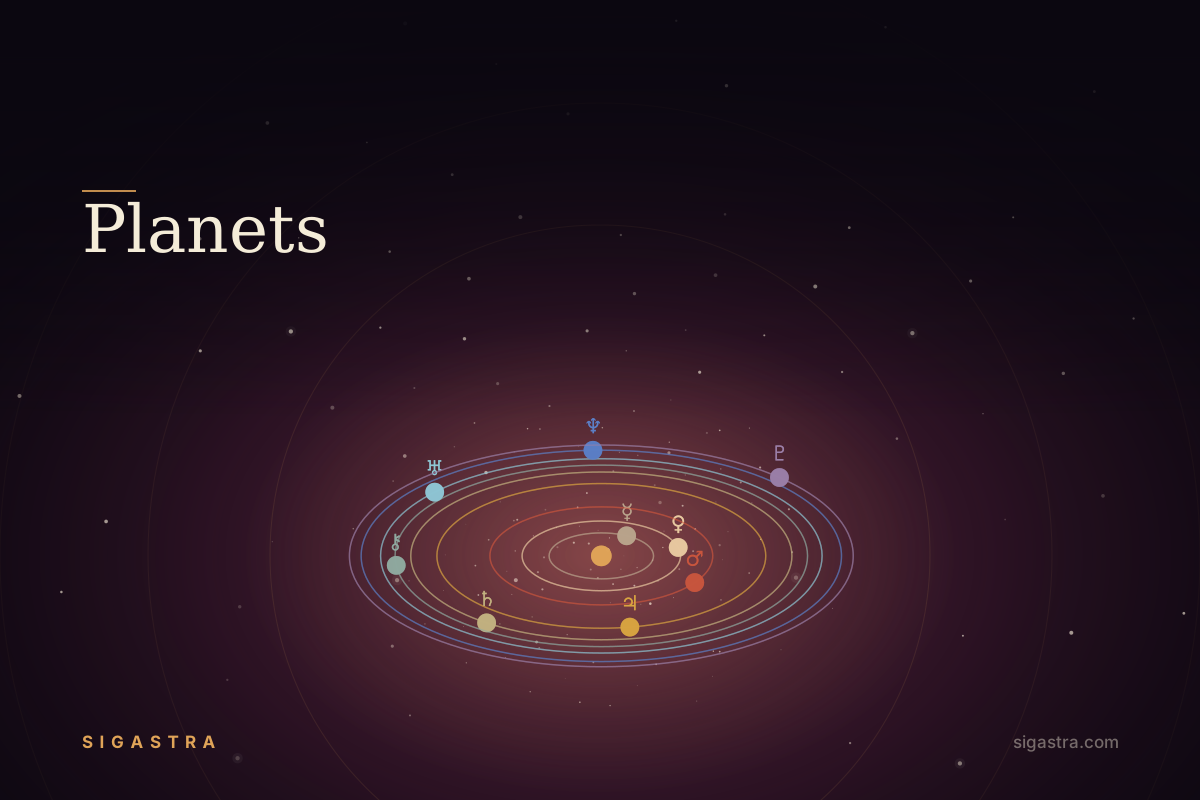
Personal, social and outer — how the ten divide up
The ten bodies astrology calls planets are not read at the same level, and knowing which group one belongs to tells you most of how much weight to give it. The personal planets are the Sun, Moon, Mercury, Venus and Mars. They move quickly enough that they differ between people born days apart, which is why they describe you rather than your generation.
Jupiter and Saturn sit in the middle and are usually called the social planets. Jupiter changes sign about once a year and Saturn every two to three, so they are shared with people born around the same time but still personal enough to describe a phase of your own life. Most of what a yearly forecast is actually reading is these two.
Uranus, Neptune and Pluto are the outer planets, and they move so slowly that everyone born within several years of you shares them. Neptune spends about fourteen years in a sign and Pluto between twelve and thirty-two. Read at the level of an individual they say very little; read at the level of a cohort they say a great deal, which is the correct way round.
Why speed decides what a planet describes
The single most useful rule for reading any planet is that its orbital period tells you the size of what it describes. The Moon crosses the whole zodiac in under a month, so it describes moods and reflexes. The Sun takes a year and describes identity. Saturn takes twenty-nine and a half and describes the structures a life is built on. Nothing about that mapping is arbitrary — it falls out of how long the cycle takes to repeat.
This is also why the same transit means different things from different planets. The Moon touching your Venus is an afternoon; Saturn touching your Venus is a couple of years and usually a real change in what you value. When two sources seem to contradict each other about a placement, the disagreement is often just that they are reading different speeds.
That is also why a question about where the planets are today is a different question from what a planet means: the first is a position you can look up for any date, the second is what the guides below are for. The practical version: if you want to understand a day, look at the Moon. A month, the Sun and Mercury. A year, Jupiter and Saturn. A decade, the outer three. Anyone promising decade-scale meaning from a fast planet, or a dated event from a slow one, has crossed the line the arithmetic draws.
Sign, house and aspect — three questions about every planet
Every planet in a chart gets read three ways, and each guide below works through all three. The sign it sits in describes the style: how that drive expresses itself. Mars in Aries and Mars in Pisces both want things, and they go about it completely differently.
The house describes the arena — which part of life the planet operates in. This is the part that needs an accurate birth time, because the houses rotate a full turn every twenty-four hours. Two people born the same day in the same city an hour apart share every sign placement and can have quite different house layouts.
The aspects describe the conversation: which other planets that one is in conversation with, and whether that conversation is easy or awkward. A planet with no close aspects tends to run in its own lane; one with several is pulled into everything. Sign, house, aspect — in that order — is the whole method, repeated ten times.
Where to start if you only read three
Start with the Sun, the Moon and Mercury. The Sun is the one you already know from horoscopes, and it does describe something real — core identity and what you are moving toward — but it is one placement out of ten and it is why general horoscopes miss so often.
The Moon is the one most people find changes their mind about astrology, because it describes the inner life rather than the public one, and it is frequently the placement that feels more like you than the Sun does. Mercury is the practical one: how you think, read, argue and explain, which shows up in every conversation you have.
After those three, the fastest route to something useful is to compute your own chart and look up the placements you actually have rather than reading all ten in order. The guides are written to be read in any sequence for exactly that reason.
Calculate your real birth chart free — then bring every idea here back to your own sky.
Calculate my birth chart