Uranus in Astrology: Learn What It Means
Uranus is the awakener of the birth chart — the planet astrology links to sudden change, freedom, rebellion, innovation and the electric jolt that breaks a stale pattern open. Where Saturn builds the walls, Uranus is the lightning that shows you which walls no longer belong there.
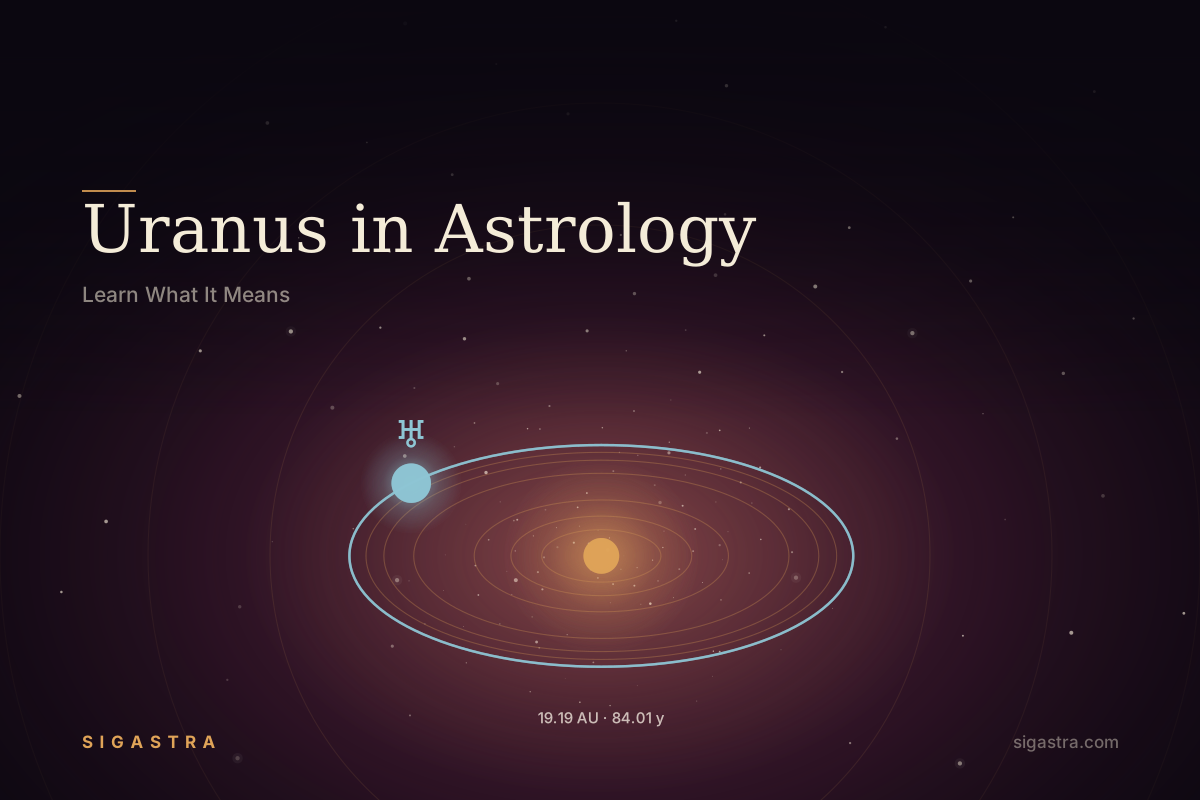
Uranus is the first of the three “outer” or “generational” planets, invisible to the naked eye and discovered only in 1781. It takes about 84 years to orbit the Sun, spending roughly seven years in each zodiac sign — so its sign describes a whole generation far more than any single person, while its house and aspects are what make it personal.
What Uranus governs in the chart
Uranus is the principle of liberation and disruption. It is the urge to be free, to be authentic, to break from convention and to leap forward rather than plod. It rules the modern sign of Aquarius and stands for everything Saturn is not: the exception rather than the rule, the future rather than the past, the sudden insight rather than the slow build. Astrology associates it with genius, invention, technology, rebellion, individuality and the moment the light bulb switches on.
Where Uranus sits in your chart is where you refuse to be boxed in — where you feel the pull to do things your own way, however unconventional, and where sudden change tends to arrive whether you invited it or not. It can feel exhilarating and destabilizing at once, because Uranus does not negotiate; it cuts. Its gift is authenticity and originality. Its challenge is restlessness, contrariness for its own sake, and the temptation to blow up something good simply because it has started to feel routine.
Uranus is often called the “higher octave” of Mercury: where Mercury reasons step by step, Uranus knows in a flash. That flash quality is why breakthroughs, awakenings and reversals cluster around it. Handled well, Uranus keeps you honest and evolving; handled poorly, it scatters your energy into constant upheaval. Reading it means asking where you genuinely need freedom, and where “freedom” is just an excuse to avoid commitment.
Uranus through the signs: a generational planet
Here the outer planets work differently from the personal ones, and it matters. Because Uranus spends about seven years in each sign, everyone born within that stretch shares the same Uranus sign. So the sign is not really about you as an individual — it describes the collective flavor of your generation, the areas where your age group instinctively rebels, innovates and demands freedom. It is a portrait of a cohort, not a personality.
You can see this in history. A generation with Uranus in a given sign tends to overturn whatever that sign governs — loosening old rules there, inventing new forms, treating as obvious what their parents found unthinkable. Uranus in an air sign might revolutionize communication and ideas; in a water sign, feeling, family and the inner life; in fire, identity and self-expression; in earth, money, work and the material order. Each seven-year group carries a different reforming mission.
This is exactly why, for Uranus, the house and the aspects tell you far more about your own life than the sign does. The sign says “which revolution your generation was born into”; the house says “where that current runs through your particular story.” When you read your chart in Sigastra, treat the Uranus sign as background and let the house bring it home.
Uranus through the houses
The house Uranus occupies is where your life is most prone to sudden change, unconventional choices and the drive for independence — and, being personal to your exact birth chart, it says far more about you than the generational sign. It marks the arena where you cannot and will not be ordinary, and where the unexpected keeps rearranging the furniture.
Uranus in the first house often reads as a visibly original, unpredictable presence — someone who wears their difference openly. In the seventh it can bring unconventional partnerships or sudden shifts in relationships, along with a fierce need for space within closeness. In the tenth it points to an unusual career path or abrupt professional turns; in the fourth, an unconventional home or a family life marked by disruption and reinvention. Wherever it lands, expect the story there to zigzag rather than run straight.
The invitation of a Uranus house is to build a life flexible enough to hold change without being shattered by it. People who fight Uranus’s house tend to get the change anyway, in more jarring form; people who work with it learn to expect the unexpected and even to court it. Its transits — when Uranus in the sky contacts your natal planets — are classic “wake-up call” periods, which is why the outer planets are best studied hand in hand with transits.
Mythology, glyph and astronomy
Uranus is unusual for being named from Greek rather than Roman mythology: Ouranos, the primordial sky god, the very first ruler of the heavens and grandfather of Zeus. In the myth Ouranos is overthrown by his own son Kronos (Saturn) — a neat cosmic joke, since astrological Uranus is precisely the force that overthrows the Saturnian order of rules and limits. The sky-god origin also fits: Uranus is airy, detached, high above the personal, concerned with the whole rather than the individual.
The glyph ♅ is often drawn as an H with a central circle — a nod to William Herschel, who discovered the planet in 1781 — or, in an older form, as a symbol combining the Sun’s circle with the crossed arrows of Mars, suggesting electric, driving energy. Either way it reads as something modern and man-made among the ancient planetary glyphs, which suits the planet of technology and invention.
Astronomically Uranus is a genuine oddball, and appropriately so. It is an ice giant that rotates almost entirely on its side, tipped over so far that its poles take turns pointing nearly at the Sun — the great rule-breaker even in its physics. It was the first planet discovered with a telescope, expanding the known solar system overnight, and it takes about 84 years to complete one orbit, which is why it lingers around seven years in each sign and behaves as a generational marker.
A quick glossary of Uranus themes
Uranus turns up in astrology under a spread of related words. This short glossary keeps the core idea — sudden, liberating change — recognizable whichever term a reading happens to use.
- Awakening
- The sudden insight or jolt that breaks an old pattern and shows a truth you can no longer unsee.
- Freedom
- The non-negotiable need for independence, space and the right to be authentically yourself.
- Rebellion
- The refusal of convention and authority — reforming at best, contrary for its own sake at worst.
- Innovation
- Genius, invention and technology; seeing the future before others and building toward it.
- Generational planet
- A slow outer planet whose sign describes an age cohort rather than an individual — read the house for you.
- Disruption
- The abrupt, unpredictable change Uranus brings — destabilizing, but often clearing space for something truer.
Living well with Uranus
Because Uranus is generational by sign, the useful work is almost always at the level of its house: the specific part of your life that will not tolerate a cage. Living well with it means building enough flexibility there that change can arrive without wrecking everything — keeping some slack in your plans, and treating the occasional shake-up as information rather than disaster. People who leave no room for Uranus tend to get the change anyway, in harsher form.
It also helps to separate genuine authenticity from mere contrariness. Not every rule is a prison, and freedom that only ever means walking away is its own kind of trap. Sigastra places Uranus, and tracks its slow transits to your natal planets, from real astronomical data — so when a classic Uranus “wake-up” season comes around, you can meet it consciously instead of being blindsided by it.
Continue learning
Frequently asked
What does Uranus mean in astrology?+
Uranus is the planet of sudden change, freedom, rebellion, innovation and awakening. In a birth chart it shows where you break from convention, insist on independence and encounter the unexpected. It rules Aquarius and is the great disruptor — the lightning bolt that jolts a stale pattern open and pushes you toward authenticity.
Why is Uranus called a generational planet?+
Because it moves so slowly — about seven years per sign over an 84-year orbit — everyone born within a roughly seven-year window shares the same Uranus sign. So the sign describes the reforming character of a whole generation rather than an individual. For personal meaning, the house and aspects of Uranus in your chart matter far more than the sign.
Does Uranus really cause sudden change?+
Astrologers associate Uranus transits with sudden shifts, breakthroughs and reversals, especially in the area of life its house governs. It is best read as a symbolic lens for reflection rather than a prediction of specific events. Sigastra maps where Uranus sits from real astronomy, so you can consider where you most need flexibility and freedom.
How long does Uranus stay in one sign?+
About seven years. Uranus takes roughly 84 years to orbit the Sun, so it spends around seven years in each of the twelve signs. That slow pace is why it is a generational planet — its sign is shared with everyone born near your era — while its house and aspects describe your individual experience.
What is the difference between Uranus and Mercury?+
Both relate to the mind, but they work differently. Mercury reasons step by step — everyday thinking, speaking and logic. Uranus is often called Mercury’s “higher octave”: it knows in a sudden flash rather than by argument, and it governs breakthroughs, genius and revolutionary ideas rather than routine thought.
Calculate your real birth chart free — every planet, sign and house computed from exact astronomy.
Calculate my birth chart