Jupiter in Astrology: Learn What It Means
Jupiter is the great expander of the birth chart — the planet astrology links to growth, optimism, opportunity and the search for meaning. Wherever Jupiter sits, life tends to feel larger, more generous and more open to possibility, which is why the old texts nicknamed it the “greater benefic.”
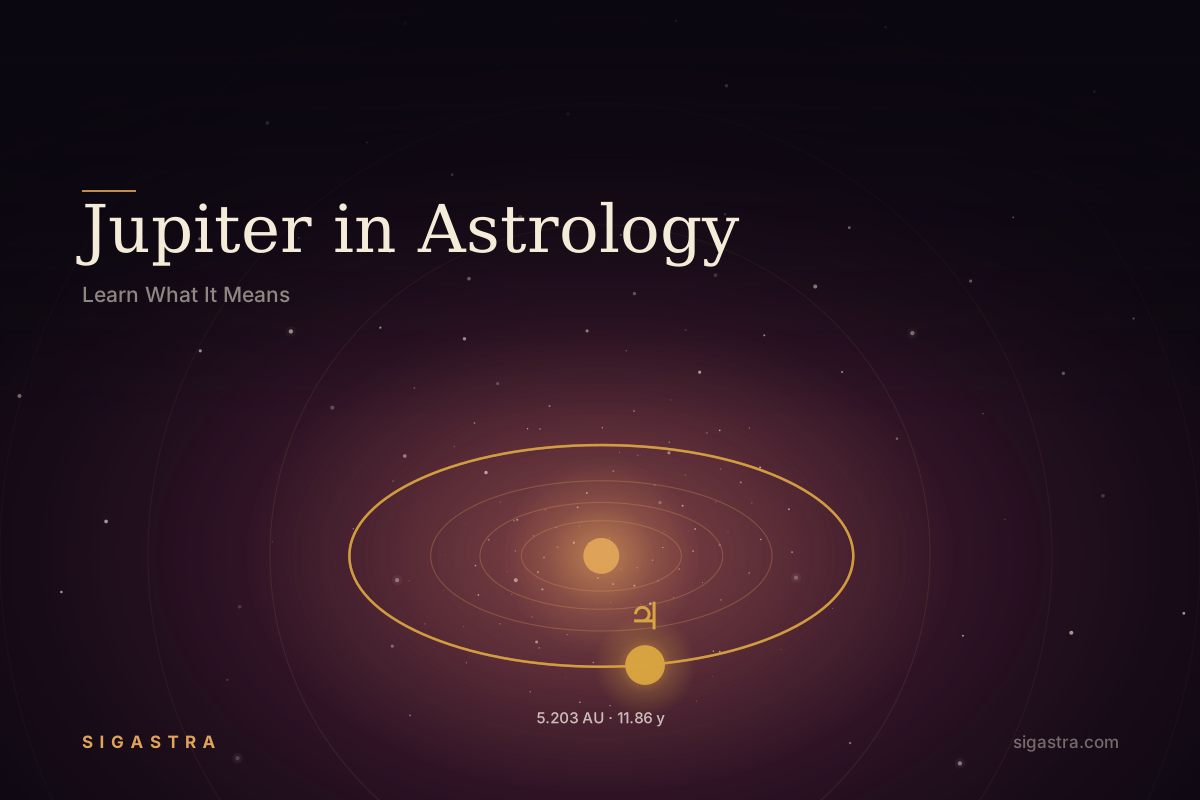
As the largest planet in our solar system, Jupiter takes about twelve years to circle the Sun, spending roughly one year in each zodiac sign. That steady rhythm makes it a bridge between the fast personal planets and the slow outer ones: personal enough to describe you, slow enough to color a whole phase of life.
What Jupiter governs in the chart
Jupiter is the principle of expansion. Where the Sun gives identity and Mercury gives thought, Jupiter gives the impulse to reach beyond what you already have — to learn more, travel further, believe in something bigger and trust that things will work out. It rules the modern sign of Sagittarius and, in traditional astrology, Pisces too, and both of those signs share Jupiter’s hunger for horizons: philosophy, faith, foreign places and the big picture.
In practice, Jupiter describes how you grow and where you find your luck. It is not luck in a lottery-ticket sense so much as a talent for seeing opportunity and saying yes to it. Jupiter is faith in the broadest meaning of the word — confidence that life is fundamentally on your side — and that confidence tends to attract exactly the openings it expects. It governs generosity, teaching, mentorship, publishing, higher education and any activity that widens your view of the world.
Jupiter has a shadow, and it is simply too much of a good thing. The same energy that expands your horizons can inflate your appetites: overconfidence, excess, promising more than you can deliver, or believing a rule does not apply to you. A well-placed Jupiter is not one that never overreaches; it is one that has learned where growth genuinely serves and where it just spills over. Reading it honestly means holding both the gift and the excess in view.
Jupiter through the zodiac signs
Because Jupiter changes sign about once a year, it is a “social” planet — slow enough to shape a personal outlook, fast enough that people born a couple of years apart usually carry a different Jupiter. Your Jupiter sign colors the style of your optimism and the arena where growth comes most naturally. It answers a simple question: when you reach for more, what does “more” look like to you?
Jupiter in a fire sign (Aries, Leo, Sagittarius) grows through boldness, adventure and self-belief; it expands by doing. In an earth sign (Taurus, Virgo, Capricorn) it grows through patience, craft and tangible results, trusting what can be built and measured. In an air sign (Gemini, Libra, Aquarius) it grows through ideas, conversation, learning and connection, widening the mind before the map. In a water sign (Cancer, Scorpio, Pisces) it grows through feeling, intuition, care and depth, finding meaning in emotional and even spiritual experience.
The sign is only the opening note. To read Jupiter properly you weave in its house and the aspects it makes to other planets — a confident Jupiter sign squeezed by a hard Saturn contact behaves very differently from the same sign running free. Sigastra places Jupiter by real ephemeris data, so the sign you see is the sign the sky actually held at your birth, not a rounded guess.
Jupiter through the houses
If the sign describes the flavor of your growth, the house shows where it concentrates — the specific department of life that keeps expanding, attracting opportunity and asking for more room. For many people the house is the more practical of the two, because it points at real situations rather than a general mood.
Jupiter in the first house tends to enlarge the personality itself — presence, optimism, a sense of possibility others feel on meeting you. In the second it looks for growth through resources, skills and self-worth. In the seventh it expands through partnership, drawn to relationships that broaden your world. In the ninth, Jupiter’s own natural house, it thrives on travel, study, publishing and belief. In the tenth it grows through career and public reputation. Each placement names a garden where Jupiter’s seeds tend to take.
A useful caution: the same house that receives Jupiter’s gifts can also receive its excess. Jupiter in the fifth might bring abundant creativity and joy — or a tendency to overdo pleasure and risk. Reading the placement well means asking not only “where do I grow?” but “where do I need to know when enough is enough?” That honest double question is where the placement stops being flattery and becomes genuinely useful self-knowledge.
Mythology, glyph and astronomy
Jupiter is named for the king of the Roman gods, the equivalent of the Greek Zeus — ruler of the sky, wielder of the thunderbolt, dispenser of law and largesse from the top of Olympus. That mythic role maps neatly onto the planet’s astrological job: authority that is meant to be benevolent, abundance that is meant to be shared, and a broad, sky-high perspective that sees the whole realm rather than one corner of it.
The glyph ♃ is usually read as a stylized number four or as an eagle, and older sources describe it as the soul (a curve) rising above the cross of matter — spirit lifting over the material world. It is a fitting emblem for the planet of faith and higher meaning, the part of the psyche that insists there is more to life than the day-to-day.
Astronomically, Jupiter earns its symbolism. It is by far the largest planet, more massive than all the others combined, banded with storms including the centuries-old Great Red Spot, and attended by dozens of moons — the four largest of which Galileo spotted in 1610, quietly helping to end the idea that everything orbits Earth. It completes one orbit of the Sun in about 11.9 years, which is why astrologers round its cycle to roughly twelve years and one year per sign.
A quick glossary of Jupiter themes
Jupiter shows up in astrology under many related words. Here is a compact map of the ideas that cluster around the planet, so the same energy is recognizable whether a chart calls it faith, luck or expansion.
- Expansion
- The core drive to enlarge, extend and reach beyond current limits — for better and, in excess, for worse.
- The greater benefic
- Jupiter’s traditional title as the planet most inclined to protect, bless and open doors.
- Faith & meaning
- The search for a bigger story — philosophy, belief, purpose — that makes experience feel worthwhile.
- Higher learning
- University, teaching, publishing, foreign cultures and long journeys of the mind or the body.
- Jupiter return
- Roughly every twelve years (around ages 12, 24, 36…) Jupiter comes back to its birth position, often marking a fresh chapter of growth.
- Excess
- Jupiter’s shadow: overconfidence, overindulgence, over-promising — growth that forgets its own limits.
Working with your Jupiter
Knowing your Jupiter sign and house is most useful as a prompt for reflection rather than a promise of easy wins. The practical question is simple: in the area of life your Jupiter marks, are you actually saying yes to growth — reaching, learning, giving, taking the generous risk — or are you coasting on the assumption that things will just work out? Jupiter rewards deliberate reaching far more reliably than it rewards passive hope.
It also helps to keep the shadow in view. If your Jupiter tends toward excess, growth may mean restraint as often as expansion — knowing when the opportunity in front of you is genuine and when it is simply appetite in a flattering disguise. Sigastra draws your Jupiter from the observatory-grade ephemerides, the same high-precision data used by astronomers, so the position you reflect on is the real one the sky held at your birth, not an approximation.
Continue learning
Frequently asked
What does Jupiter mean in astrology?+
Jupiter is the planet of growth, optimism, opportunity and meaning. In a birth chart it shows where you naturally expand, find confidence and encounter good fortune — as well as where you may overdo things. It rules Sagittarius (and traditionally Pisces) and is nicknamed the “greater benefic” for its generally supportive influence.
Is Jupiter really the planet of luck?+
Astrologically, yes — but it is worth understanding what that means. Jupiter’s “luck” is less about random chance and more about optimism, openness and a knack for seeing and seizing opportunity. It describes a temperament that expects doors to open, which often helps them open. It is a lens for reflection, not a guarantee of outcomes.
What is a Jupiter return?+
A Jupiter return happens about every twelve years, when Jupiter comes back to the exact sign and degree it occupied at your birth — near ages 12, 24, 36, 48 and so on. Astrologers read these as natural turning points for growth, expansion and fresh opportunity, a chance to widen your life in the area Jupiter rules for you.
How long does Jupiter stay in one sign?+
About one year. Jupiter takes roughly 11.9 years to orbit the Sun, so it moves through each of the twelve zodiac signs in approximately twelve months. That makes it a “social” planet — personal enough to describe your outlook, yet slow enough to color a whole phase of life.
How do I find my Jupiter sign?+
Because Jupiter changes sign roughly once a year, your birth date is usually enough to place it, though a full chart is more precise. Sigastra calculates your exact Jupiter sign, house and aspects from real astronomical data using the free birth chart calculator, so you see the position the sky actually held when you were born.
Calculate your real birth chart free — every planet, sign and house computed from exact astronomy.
Calculate my birth chart