Astrological Aspects: How Planets Talk
A birth chart is more than a list of planets in signs and houses — it is a web of relationships. Aspects are the angular relationships between planets, the specific distances that astrology treats as meaningful conversations between them. When two planets sit at a notable angle, they influence each other, and reading those links is what turns a static map into a living portrait.
Aspects are measured in degrees around the 360-degree wheel, and only a handful of angles count as major. Some feel supportive and easy, others feel tense and demanding, but none is simply good or bad. The tense ones often drive growth, while the easy ones can slip by unused. Learning to read aspects is where chart interpretation really comes alive.
What an aspect is and how orbs work
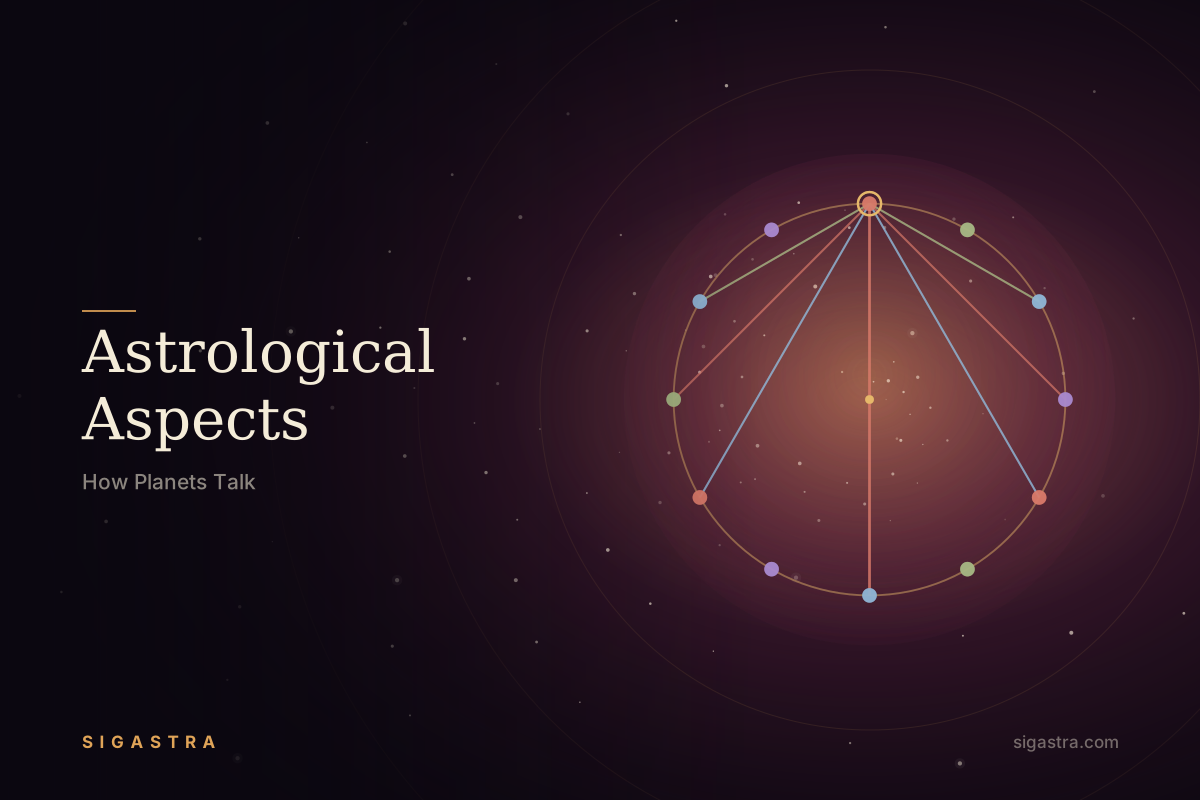
An aspect is the angular distance between two points in the chart, measured along the zodiac circle. If you stand one planet at zero degrees and another one hundred and twenty degrees away, they form a trine. The five classical major aspects divide the circle in simple ways — into halves, thirds, quarters, and sixths — which is part of why astrologers consider them the most potent.
Real planets rarely sit at a perfect exact angle, so astrology allows a margin called the orb. If a trine is exact at one hundred and twenty degrees, an orb of, say, six degrees means planets between one hundred and fourteen and one hundred and twenty-six degrees apart still count as trine, with the effect strongest near exactness. Faster, more personal bodies like the Sun and Moon are usually granted wider orbs than distant planets.
Sigastra measures these angles from precisely computed positions, so an aspect in your chart reflects the real geometry of the sky at your birth. The tighter the orb, the more clearly that conversation between the two planets tends to register.
The five major aspects
Five angles do most of the work in a chart. Here they are with their exact degrees and the flavour each one brings. Read them as tones of relationship between two planets rather than as verdicts.
- Conjunction — 0°
- Two planets sit together and merge their energies into a single, concentrated force. Powerful and defining; the flavour depends on whether the planets get along.
- Sextile — 60°
- A supportive, opportunity-shaped angle. The planets cooperate easily, but the potential often needs a nudge to be used rather than arriving automatically.
- Square — 90°
- A tense, friction-filled angle that creates pressure and challenge. Uncomfortable, but one of the strongest engines of motivation and growth.
- Trine — 120°
- A flowing, harmonious angle where the planets support each other naturally. Talents come easily here, sometimes so easily they are taken for granted.
- Opposition — 180°
- Two planets face off across the chart, pulling in opposite directions. It brings awareness and balance through tension, often played out with other people.
Harmonious versus challenging aspects
Astrologers loosely sort aspects into two families. The harmonious, or soft, aspects — mainly the trine and sextile — describe energy that flows without much resistance. Planets linked this way cooperate; the associated talents feel natural and available. The catch is that ease can breed complacency, and gifts that never meet friction sometimes go undeveloped.
The challenging, or hard, aspects — chiefly the square and opposition — describe tension. Planets linked this way pull against each other, producing friction, effort, and occasional frustration. Yet this is precisely where growth tends to happen: hard aspects push you to act, to reconcile competing drives, and to build strength you would never develop from ease alone.
The conjunction sits outside this split. It intensifies whatever it touches, and its feel depends entirely on the planets involved — two cooperative planets conjunct feel very different from two that clash. The healthiest reading treats all aspects as workable material rather than luck or misfortune.
Reading aspects in your own chart
Begin with the tightest aspects — the ones closest to exact — because these usually speak the loudest. An aspect within a degree or two of exactness tends to be a defining feature of the personality, while a wide one operates more as background texture. Sorting by orb is one of the quickest ways to find what matters most.
Then name the two planets and ask what each wants. A square between Venus, which seeks connection and pleasure, and Saturn, which seeks structure and caution, describes a real inner negotiation between warmth and restraint. The angle tells you the tone of that negotiation; the planets tell you what is being negotiated.
Notice when several aspects cluster into a pattern, such as a grand trine or a T-square. These configurations bind three or more planets into a single storyline and often describe a central theme of the chart. You do not need to catalogue every minor angle to read well — the major aspects between the personal planets carry most of the meaning.
It also helps to consider whether an aspect is applying or separating. When the faster planet is still moving toward exactness, the aspect is applying and tends to feel more active and forward-leaning; when it has already passed the exact angle, it is separating and reads as something more settled or worked through. In a birth chart this nuance is subtle, but it becomes vivid with transits, where the same planets move day by day. Holding all of this loosely, and starting from the tightest major aspects, keeps a first reading focused rather than overwhelming.
What aspects can and cannot tell you
Aspects are genuinely useful for understanding inner dynamics — why two parts of you seem to pull in different directions, or why certain talents feel effortless. They map the internal conversation between your planets, which is why they add so much depth beyond a simple sign-by-sign read.
What they do not do is dictate outcomes. A challenging aspect is not a sentence to a difficult life, and a harmonious one is not a guarantee of good fortune. The same square can be lived out as chronic frustration or as hard-won mastery; the geometry sets the theme, not the ending.
Sigastra presents aspects as a mirror for reflection and self-knowledge. They are a language for thinking about your own patterns with more honesty and nuance — never deterministic prediction, and never advice on medical, financial, or legal matters.
Aspect patterns and minor aspects
Individual aspects are the alphabet; aspect patterns are the words they spell. When three or more planets link into a recognisable shape, astrologers give it a name and read it as a single storyline. A grand trine joins three planets in a flowing triangle and describes an area of natural, easy talent. A T-square joins two planets in opposition, both squaring a third, and describes a dynamic tension that drives a great deal of a person's ambition. A stellium gathers three or more planets close together, concentrating enormous energy in one sign or house.
These configurations often mark the central themes of a chart, so it is worth learning to spot them. A T-square, for example, points to a focal planet that carries the pressure of the whole pattern, and understanding that planet frequently unlocks the chart. The shapes are not better or worse than one another; they simply describe how several drives are wired together.
Beyond the five majors there are minor aspects — the semi-sextile at thirty degrees, the quincunx at one hundred and fifty, the semi-square at forty-five, and others — read with much tighter orbs and a subtler voice. The quincunx, linking two signs with nothing in common, is especially interesting: it describes an awkward, adjust-as-you-go relationship between planets that never quite settles. Beginners can safely set the minors aside at first and return to them once the major aspects feel natural.
A practical tip: when you meet a new pattern, resist the urge to label it good or bad and instead ask what it is asking of you. A grand trine may need deliberate effort to put its easy gifts to use; a T-square may be quietly responsible for your best work precisely because it never lets you settle. Read the shapes as descriptions of how your energies are wired together, and they become far more useful than a simple tally of lucky and unlucky angles.
Continue learning
Frequently asked
What is an orb in astrology?+
An orb is the margin of degrees allowed around an exact aspect. If a trine is exact at 120 degrees, an orb of a few degrees means angles slightly wider or narrower still count, with the effect strongest closest to exact.
Are challenging aspects bad?+
No. Squares and oppositions create tension, but that tension is one of the strongest drivers of growth and motivation. They describe effort and negotiation, not misfortune or a fixed outcome.
Which aspects are the most important in my chart?+
Generally the tightest aspects, those closest to exact, and aspects involving the personal planets like the Sun, Moon, Mercury, Venus, and Mars. Start with those before worrying about wider or minor angles.
What is the difference between a conjunction and an opposition?+
A conjunction places two planets together at 0 degrees so their energies merge and intensify. An opposition places them 180 degrees apart, facing off and seeking balance through tension, often in the arena of relationships.
Do aspects change over time?+
The aspects in your birth chart are fixed for life, since they reflect the sky at your birth. Transiting aspects, formed by today's moving planets to your natal chart, come and go and are read separately.
Calculate your real birth chart free — every planet, sign and house computed from exact astronomy.
Calculate my birth chart