What Is Astrology? A Clear, Honest Introduction
Astrology is the practice of studying the positions of the Sun, Moon and planets and reading meaning into the patterns they form. For thousands of years, people have looked up, tracked those moving lights against the fixed backdrop of the stars, and used what they saw to think about time, character and the shape of a life. At its simplest, astrology is a language for reflection built on top of the real, observable sky.
It is worth being honest from the start. Astrology is not a science, and it cannot predict your future the way a weather forecast predicts rain. What it can do is give you a rich, structured vocabulary for self-knowledge and a prompt to look at your life from a different angle. That is the spirit in which Sigastra treats it: the astronomy is exact, the interpretation is human, and the point is reflection rather than fortune-telling.
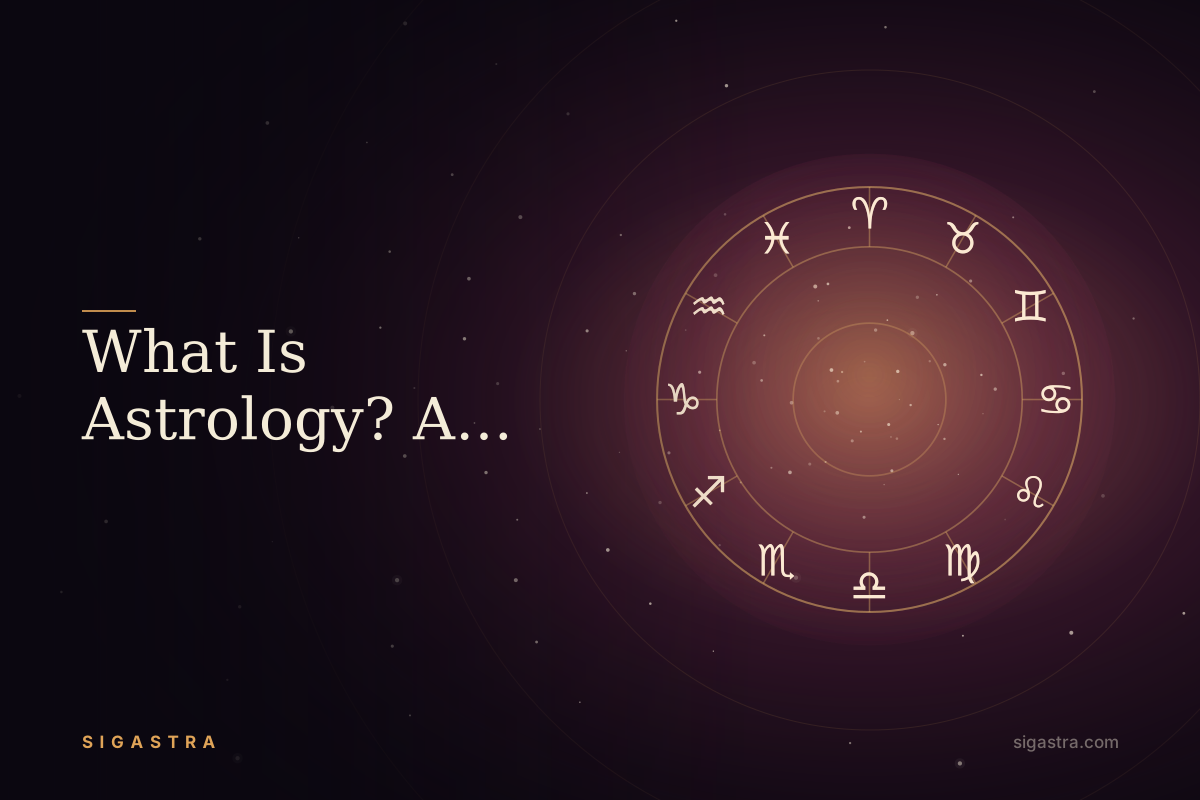
A working definition of astrology
Astrology proposes that there is meaning in the arrangement of the sky at a given moment, and especially at the moment a person is born. The core idea is symbolic correspondence: the Sun stands for identity and vitality, the Moon for emotion and instinct, and each planet for a different theme, such as communication, love or discipline. Where these bodies sit against the twelve zodiac signs, and how they line up with one another, is read as a kind of portrait.
This is quite different from astronomy, though the two share the same starting data. Astronomy studies the physical universe: what stars are, how planets orbit, what light and gravity do. Astrology takes those same measured positions and asks a human question instead of a physical one, treating the sky as a mirror for character and timing rather than as a machine to be explained.
Because it works with symbols, astrology is interpretive by nature. Two thoughtful astrologers can read the same chart and emphasise different things, much as two critics can read the same novel differently. That flexibility is part of why astrology has lasted, and also part of why it should never be mistaken for a hard predictive science.
A very short history
Astrology has deep roots. The Babylonians kept careful records of planetary movements more than two thousand years before the common era, largely to advise kings and mark the calendar. Those observations were remarkably accurate for their time and formed the raw material that later traditions inherited. Astronomy and astrology grew up together, as a single study of the sky.
The zodiac of twelve signs took shape in the ancient Mediterranean world, and Greek and Hellenistic thinkers built much of the framework still used today, including houses, aspects and the idea of a personal birth chart. From there astrology spread through the Islamic world, medieval Europe, India and beyond, each culture adapting it. For centuries it sat comfortably alongside medicine, agriculture and statecraft.
The two fields separated during the scientific revolution, as astronomy became a rigorous physical science and astrology moved into the realm of symbolism and self-understanding. Modern astrology, especially the psychological style popular today, focuses less on predicting events and more on character, growth and meaning.
How astrology is actually calculated
Whatever you think of the interpretation, the calculation underneath is genuine astronomy. To build a chart you need three things: the exact date, the exact time and the exact place. From those, an astrologer or a program works out precisely where every celestial body sat in the sky as seen from that spot on Earth at that instant.
The bodies move at very different speeds, which is why timing matters so much. The Sun travels roughly one degree per day and spends about a month in each zodiac sign. The Moon is far quicker, changing sign about every two and a half days. The Ascendant, or Rising sign, is fastest of all, moving through the whole zodiac every twenty-four hours, which is exactly why your birth time changes the chart so dramatically.
Sigastra performs these calculations with the observatory-grade ephemerides, the same high-precision astronomical engine used in serious astronomy and astrology software, and it accounts for time zones and historical daylight-saving rules. In other words, the numbers are not made up; they describe the real sky. The interpretation is where human meaning enters.
What the main pieces mean
A birth chart is made of a few repeating parts, and once you know them the whole subject becomes far less mysterious. Learning these four categories is the single most useful step for a beginner.
- Planets
- The what. Each body, from the Sun and Moon to Saturn and beyond, represents a drive or function such as identity, emotion, thought or love.
- Signs
- The how. The twelve zodiac signs colour the style and tone of whatever planet sits in them, like an adjective describing a verb.
- Houses
- The where. The twelve houses map planets onto areas of life such as home, work, relationships and money, and they depend on your birth time.
- Aspects
- The conversations. The angles planets make to one another show how the different parts of you cooperate or pull against each other.
What astrology can and cannot do
Used well, astrology is a tool for reflection. It can offer language for parts of yourself that are hard to name, suggest patterns worth noticing, and prompt useful questions about timing, relationships and growth. Many people find that a good chart reading feels less like being told the future and more like being handed a thoughtful mirror.
It cannot, however, tell you what will happen, and it should never replace professional advice. Astrology is not a substitute for a doctor, a therapist, a lawyer or a financial adviser, and any reading that claims certainty about health, money or major life decisions is overreaching. The sky does not compel you; at most, in the traditional phrase, it inclines.
The most grounded way to use astrology is to hold it lightly. Take what resonates, test it against your own experience, and leave the rest. It works best as a starting point for self-inquiry, not as a set of instructions, and certainly not as a way to hand your choices over to the stars.
Common misconceptions worth clearing up
A great deal of confusion around astrology comes from a few persistent myths. The first is that astrology claims the planets physically control your life by beaming down influence. Serious astrology makes no such mechanical claim; it treats the sky as a symbolic mirror that reflects meaning, not as a set of remote controls pulling your strings. The old maxim that the stars incline but do not compel captures this well.
A second misconception is that your Sun sign is your whole astrological identity. In reality the Sun sign is a single placement among many, and reducing a person to one of twelve types is exactly the kind of oversimplification that gives astrology a bad name. A genuine reading works from the full chart, where dozens of factors interact and no two people are quite alike.
A third myth is that astrology and modern astronomy are enemies. Historically they were one study, and astrology still relies entirely on accurate astronomical data to place the planets. The disagreement is not about where the planets are, which both fields calculate identically, but about whether those positions carry personal meaning, a question that sits outside science altogether.
Continue learning
Frequently asked
Is astrology a science?+
No. Astrology uses precise astronomical data, but its interpretations are symbolic rather than experimentally verified, so it is not a science. It is best understood as a language for reflection and self-knowledge rather than a predictive discipline.
Is astrology the same as astronomy?+
They share the same starting measurements but ask different questions. Astronomy studies the physical universe and how it works, while astrology reads human meaning into where the planets sit. The two grew up together as a single study of the sky and only separated a few centuries ago, during the scientific revolution.
Can astrology predict my future?+
Not in any reliable, literal sense. Astrology can highlight themes and timing worth reflecting on, but it cannot foretell specific events. Anyone promising certainty about your future is overstating what the practice can honestly offer.
Do I need to believe in astrology to find it useful?+
No. Many people engage with astrology simply as a structured prompt for self-reflection, much like journaling or a personality framework. You can explore your chart with curiosity and keep only the parts that genuinely resonate with your experience. Belief is optional; usefulness is what matters, and that you can judge for yourself.
How accurate are Sigastra’s calculations?+
The astronomical positions are highly accurate. Sigastra uses the observatory-grade ephemerides and handles time zones and daylight saving correctly, so the sky it describes is the real one. The interpretation layered on top is symbolic and meant for reflection.
Calculate your real birth chart free — every planet, sign and house computed from exact astronomy.
Calculate my birth chart